Share this post


.svg)

Most B2B companies are still hiring the same way they did in 2018: add headcount, run sequences, hope for meetings. But a new type of operator has emerged that makes that model look expensive and inefficient. GTM Engineers are building automated revenue systems that outperform entire SDR teams, and the companies that figure this out first are winning pipeline while everyone else is still posting job descriptions.
Quick Answer: A GTM Engineer is a technical go-to-market specialist who designs, builds, and automates the systems that drive pipeline generation and revenue. They combine deep sales operations knowledge with engineering-level technical skills to replace manual, rep-dependent processes with scalable, data-driven revenue infrastructure, doing the work that previously required multiple specialized hires.
Key Takeaways:
- A GTM Engineer sits at the intersection of revenue strategy and technical automation, owning the full GTM tech stack including tools like Clay, HubSpot/Salesforce, ZoomInfo, and Apollo.
- The role emerged as a direct response to collapsing outbound response rates and the rise of AI-powered automation tools that one skilled operator can use to replace 3-4 manual processes.
- GTM Engineering is a build function; RevOps is a management function. They are not the same role and serve different organizational needs.
- US-based senior GTM Engineers command $130K–$200K+ base salary in 2026, which is driving demand for offshore alternatives and fractional models.
- Most SMBs don't need a single $180K hire, they need a coordinated team that delivers the same outcomes, which is achievable through offshore staffing at a fraction of the cost.
A GTM Engineer is a technical go-to-market specialist who designs, builds, and automates the systems that drive pipeline generation and revenue, combining sales operations knowledge with engineering-level skills to replace manual processes with scalable, data-driven revenue infrastructure across the full GTM tech stack.
That definition matters because the term gets misused constantly. People call senior SDRs "GTM Engineers." They label RevOps analysts with the title. Neither is accurate. A real GTM Engineer writes automation workflows, architects CRM data models, connects APIs across tools without help from a software engineering team, and builds systems that generate pipeline even when no human is actively working them.
The "engineer" part isn't decorative. It describes how they think and what they produce.
The role didn't exist in any meaningful way five years ago. It exists now because the conditions that made traditional sales headcount effective have fundamentally changed.
Cold outbound response rates have been declining for years. According to research published by TOPO/Gartner ↗, average cold email response rates dropped below 1% for most industries by 2023, and continued falling as inboxes became more defended and buyers became more skeptical. The SDR model built on volume sequencing, where you hire more reps to send more emails, stopped working as a linear growth lever.
"The notion that you can simply hire 10 more SDRs and get 10x the pipeline is collapsing. What scales now is the system underneath the rep, not the rep count itself."
That shift forced revenue teams to look at what was actually generating pipeline. The answer, increasingly, was systems: enrichment workflows that automatically sourced, scored, and routed the right leads; automated sequences with personalization built in at scale; CRM architectures that surfaced the right signals at the right time.
Those systems need someone to build and maintain them. That's the GTM Engineer.
Clay changed everything in 2023 and 2024. Before Clay, building a waterfall enrichment workflow, pulling data from ZoomInfo, falling back to Apollo, running it through LinkedIn enrichment, scoring it with custom logic, and routing to the right sequence, required a data engineer, a sales ops analyst, and a marketing ops person working in coordination.
Clay compressed that stack into a single tool a technically skilled operator can run alone. Then AI models (including OpenAI API integrations built directly into Clay tables) let that same operator write personalized outreach at scale without a copywriter.
One skilled GTM Engineer with the right stack can now do what three separate specialists used to do, and do it faster, more consistently, and with better data quality. That's the math behind "replacing 3 sales hires at once."
The day-to-day work spans five main domains. Most job descriptions undersell the technical depth involved.
A GTM Engineer owns the tooling decisions. Not just "we use HubSpot", they decide which tools connect to which, how data flows between them, what the source of truth is for each data type, and when a new tool is genuinely additive versus just adding complexity.
In 2026, a typical GTM tech stack they'd manage includes:
They don't just use these tools. They architect how they work together.
This is the core build work. A GTM Engineer designs the logic that moves a lead from "unknown" to "in active sequence" without a human touching it manually.
A simple example: a trigger fires when a target company visits your pricing page (via a visitor identification tool like RB2B). That trigger pulls the company into a Clay table, enriches the domain against ZoomInfo data, identifies the three most relevant contacts by job title, scores them against your ICP criteria, and pushes the highest-scoring contact into a personalized sequence in Smartlead, all before a human rep even knows the visit happened.
That's one workflow. A mature GTM system might have 15–20 such workflows running simultaneously.
Bad data is the single biggest killer of outbound performance. GTM Engineers build the data infrastructure that keeps CRM records clean, enriched, and actionable. This includes waterfall enrichment (trying multiple data sources in sequence until you get a match), deduplication logic, lead routing rules, and lifecycle stage definitions.
CRM architecture matters more than most companies realize. If your Salesforce or HubSpot is a mess of duplicate records, undefined lifecycle stages, and missing fields, no amount of outbound activity is going to produce reliable pipeline. A GTM Engineer fixes that at the architecture level, not by manually cleaning records, but by building the systems that prevent the mess from accumulating.
This is where the "engineer" credential becomes non-negotiable. Most modern GTM tools expose APIs. A GTM Engineer can connect them directly, pulling data from one tool, transforming it, pushing it to another, without filing a ticket to the software engineering team.
They understand webhooks, REST API calls, JSON data structures, and authentication flows. They can write basic Python or JavaScript when no-code tools don't have the flexibility they need. This API integration fluency is what separates a true GTM Engineer from a Sales Ops analyst who's learned a few new tools.
GTM Engineers don't just build things, they instrument them. Every workflow they build should tie back to measurable revenue outcomes: meetings booked, pipeline generated, deals influenced, revenue attributed.
This means building dashboards that track system performance, running A/B tests on sequence logic, and iterating based on data. It's the application of engineering thinking (build, measure, iterate) to revenue generation.
This is probably the most common confusion in the market right now, and it matters for hiring decisions.
RevOps (Revenue Operations) is focused on aligning sales, marketing, and customer success processes, managing reporting and forecasting, and ensuring the existing revenue engine runs efficiently. RevOps analysts maintain what's already built. They're optimizing and reporting on a system.
GTM Engineers build net-new systems. When a company needs a new lead routing workflow, a new enrichment pipeline, or a new outbound automation sequence, that's GTM Engineering work, not RevOps work.
Think of it this way: RevOps is the operations manager of a factory. A GTM Engineer is the industrial engineer who designs new machines for that factory.
The overlap happens in CRM management and data quality. Both roles care about clean data and accurate reporting. Both interact with the CRM daily. But their relationship to that data is different: RevOps uses it to report upward; GTM Engineers use it as input to automation systems.
In smaller companies, one person might wear both hats. As teams grow, the functions diverge.
If you don't have basic sales process documentation, a functioning CRM, and at least a few reps working a consistent outbound motion, you need RevOps (or even just sales ops basics) before you need a GTM Engineer.
GTM Engineering amplifies what's already working. If nothing is working yet, building sophisticated automation on top of a broken process just makes the broken process faster.
| Dimension | GTM Engineer | Sales Ops | Marketing Ops | RevOps |
|---|---|---|---|---|
| Primary Focus | Building automation systems for pipeline generation | Enabling sales reps and managing process | Managing marketing automation and campaigns | Aligning all revenue functions; reporting and forecasting |
| Core Output | Working automation workflows, integrated tech stack | Process documentation, rep enablement, CRM hygiene | Campaign execution, lead scoring, email automation | Dashboards, forecasting models, cross-functional alignment |
| Technical Depth | High, APIs, webhooks, no-code/low-code, SQL | Medium, CRM admin, reporting tools | Medium, MAP (Marketo, HubSpot) admin, HTML/CSS | Medium, BI tools, CRM reporting, some SQL |
| Pipeline Interaction | Builds systems that generate pipeline | Supports reps working pipeline | Generates leads that enter pipeline | Reports on pipeline health and velocity |
| Tool Ownership | Clay, CRM, enrichment tools, sequencing, APIs | CRM, sales enablement tools, reporting | MAP, advertising platforms, analytics | CRM, BI tools, forecasting software |
| Typical Background | Sales + technical; often self-taught engineering | Sales, business operations | Marketing, digital marketing, some technical | Finance, operations, sales leadership |
| When You Need It | When you have working outbound and want to scale it with systems | When reps need process and infrastructure support | When marketing campaigns need to be systematic | When you need visibility and alignment across revenue functions |
The toolset has stabilized around a core set of platforms, though new tools emerge constantly and a good GTM Engineer stays current.
Clay has become the central platform in modern GTM Engineering the way Salesforce became central to CRM. It's a data orchestration tool that lets you pull from 50+ data sources, build enrichment waterfalls, apply AI-powered logic, and push outputs to CRM or sequencing tools, all in a spreadsheet-like interface with no coding required for most use cases.
A GTM Engineer fluent in Clay can build in hours what would have taken a full data team days in 2022. The ability to use the OpenAI API ↗ directly inside Clay tables, to write personalized email snippets, summarize company news, or extract job change signals, collapsed the personalization labor cost entirely.
If a candidate says they're a GTM Engineer but has never touched Clay, that's a significant red flag in 2026.
HubSpot and Salesforce remain the two dominant CRM platforms in B2B. The choice between them usually reflects company size and complexity: HubSpot for SMBs and growth-stage teams (up to ~500 employees in most cases), Salesforce for enterprises with complex multi-object data models.
A GTM Engineer needs to do more than click through the UI. They should understand object relationships, custom property creation, workflow automation logic within the CRM, and how to build a clean lifecycle stage model that accurately reflects where buyers are in the funnel. Bad CRM architecture undermines every other system they build.
ZoomInfo and Apollo are the two most commonly used contact data providers in B2B sales. ZoomInfo offers richer company data and more phone numbers; Apollo is more cost-effective and has strong email coverage. Most mature GTM systems use both in a waterfall, try ZoomInfo first, fall back to Apollo, then potentially to LinkedIn scraping or other sources.
Beyond contact data, tools like Bombora provide intent data (which companies are actively researching topics relevant to your product), and Clearbit/Reveal-type tools identify anonymous website visitors. A GTM Engineer knows which layer of data intelligence to apply at which stage of the pipeline generation process.
Systems-led growth means pipeline is generated by the system, not by individual rep effort. That requires a sequencing infrastructure that's reliable, deliverable, and measurable.
Tools like Smartlead, Instantly, or the enterprise options (Outreach, Salesloft) handle sequence execution. But sending alone doesn't work, email deliverability infrastructure (properly warmed sending domains, SPF/DKIM/DMARC configuration, inbox rotation) has to be built and maintained. A GTM Engineer manages all of it.
According to Litmus' 2025 State of Email report ↗, poor email deliverability directly impacts up to 21% of legitimate marketing emails, making deliverability infrastructure management a critical function, not an afterthought.
The non-negotiable technical skills in 2026:
Technical skill without commercial context produces impressive systems that generate bad pipeline. A GTM Engineer needs to understand ICP definition, the difference between MQL and SQL quality, what a good meeting booked rate looks like versus a bad one, and how to calculate the downstream value of pipeline improvements.
They need to be able to look at a funnel and say "the problem is between MQL and SQL, not between SQL and opportunity", and then build the system that fixes that specific bottleneck.
This is why GTM Engineers command premium pay. Revenue-focused people who can also build technical systems are genuinely rare. Most salespeople don't understand APIs. Most engineers don't understand pipeline economics. GTM Engineers sit at the intersection, which makes them expensive and hard to find.
Based on 2026 compensation data from sources including Levels.fyi ↗ and job postings across LinkedIn and specialized boards:
Variable compensation is common. Many roles include performance bonuses tied to pipeline generated or conversion rate improvements, pushing total compensation above base figures.
The premium reflects supply-demand imbalance. The GTM Engineer title has only been mainstream for 2–3 years, so there aren't many people with 5+ years of experience in the role. Those who do exist can choose between multiple offers.
For a Series A or B company, a senior GTM Engineer hire represents $180K–$220K in fully-loaded annual cost (base + benefits + equity + tools budget). For most SMBs, that number isn't feasible, which is exactly why the offshore and fractional models discussed below have grown rapidly.
A note on the $400K–$500K engineering salary question: People searching for engineering salaries at that level are usually finding data about software engineers at FAANG-tier companies (Meta, Google, Apple, Amazon, Netflix). Those figures reflect total comp (base + RSUs + bonus) for senior or staff-level software engineers at the highest-paying employers in the industry. GTM Engineers are not software engineers and are not compensated on that scale. If you're comparing talent costs across engineering types, make sure you're comparing the right role.
These are real signals that indicate GTM Engineering support will produce ROI:
A company typically doesn't need a GTM Engineer at zero revenue. At that stage, you need founders doing outbound and validating ICP manually. The right time is usually:
Pre-revenue or very early-stage companies should focus on basic process before building automation infrastructure. You can't automate your way to product-market fit.
The honest answer: you probably can't find a single offshore hire who embodies all of the GTM Engineer skill set at the level a US-based senior would. The role combination is genuinely rare everywhere.
But you can decompose the role into component functions and staff each one with a high-quality offshore specialist, achieving the same outcomes at a dramatically lower total cost.
The GTM Engineer role decomposes into roughly four functional areas:
Each of these can be performed by a skilled offshore specialist. Hiring an offshore data analyst to manage your enrichment workflows, an offshore email marketing specialist to manage your outbound infrastructure, and dedicated offshore sales reps to run your sequences gets you most of the GTM Engineering outcome at perhaps 25–35% of the cost of a single senior US-based hire.
The key is architectural clarity. Someone on your team (a founder, a VP of Sales, or a fractional GTM strategist) needs to own the system design. The offshore team executes and maintains that system.
This model works well when:
It doesn't work when you're asking the offshore team to invent the GTM strategy from scratch. Offshore execution amplifies a good system; it doesn't replace the thinking that creates one. Read the best countries to hire offshore SDRs in 2026 for a breakdown of where to source top outbound talent by region.
Here's what a realistic offshore GTM stack looks like for an SMB with a $15K–$25K/month offshore budget:
Total: roughly $12K–$18K/month for a team delivering the output of a senior GTM Engineer plus two SDRs. Compare that to $180K–$220K for the GTM Engineer alone, plus $80K–$100K per SDR. The math is not subtle.
For a detailed look at how offshore SDR onboarding works in practice, the offshore SDR onboarding playbook covers the first 30 days of getting an offshore sales rep productive.
Most GTM Engineer job descriptions on LinkedIn right now are written by people who don't fully understand the role. Common mistakes:
A better job description focuses on outcomes: "You will build the systems that generate 200+ qualified leads per month from outbound. You will own our Clay infrastructure, our CRM data quality, and our sequence performance. You will be measured on meetings booked and pipeline created."
Include the actual tools they'll own. Include the real work test in the application process. Be honest about what the role is.
What to include in your GTM Engineer job description:
This is the most important part of the hiring process and the step most companies skip.
A practical real work test for a GTM Engineer role:
Red flags to watch for in interviews:
Remote Growth Partners, an offshore sales and marketing staffing firm, uses a 4-stage vetting process to validate both technical and commercial skills before any placement: a video screen to assess communication and baseline fit, a job preview test where candidates demonstrate specific tool proficiency, a deep interview probing system design thinking and commercial acumen, and a paid real work test that mirrors actual day-one tasks. This process is applied to every role they place, not just senior ones. You can learn more about how Remote Growth Partners vets offshore candidates before any placement is made.
A GTM Engineer is a technical go-to-market specialist who builds and automates the revenue systems that generate B2B pipeline, combining CRM architecture, automation workflow design, API integration, and data enrichment into a single high-use role. The GTM engineer role emerged between 2023 and 2026 as outbound response rates declined and tools like Clay enabled one skilled operator to replace multiple manual functions. US-based senior GTM Engineers command $150K–$200K+ in base salary, making offshore team alternatives increasingly attractive for SMBs. GTM Engineering is distinct from RevOps: RevOps manages existing processes, while GTM Engineering builds net-new systems. Companies can achieve similar GTM engineering outcomes by building a coordinated offshore team combining an offshore data analyst, offshore SDRs, and an email marketing specialist at 25–35% of the cost of a single US-based senior hire.
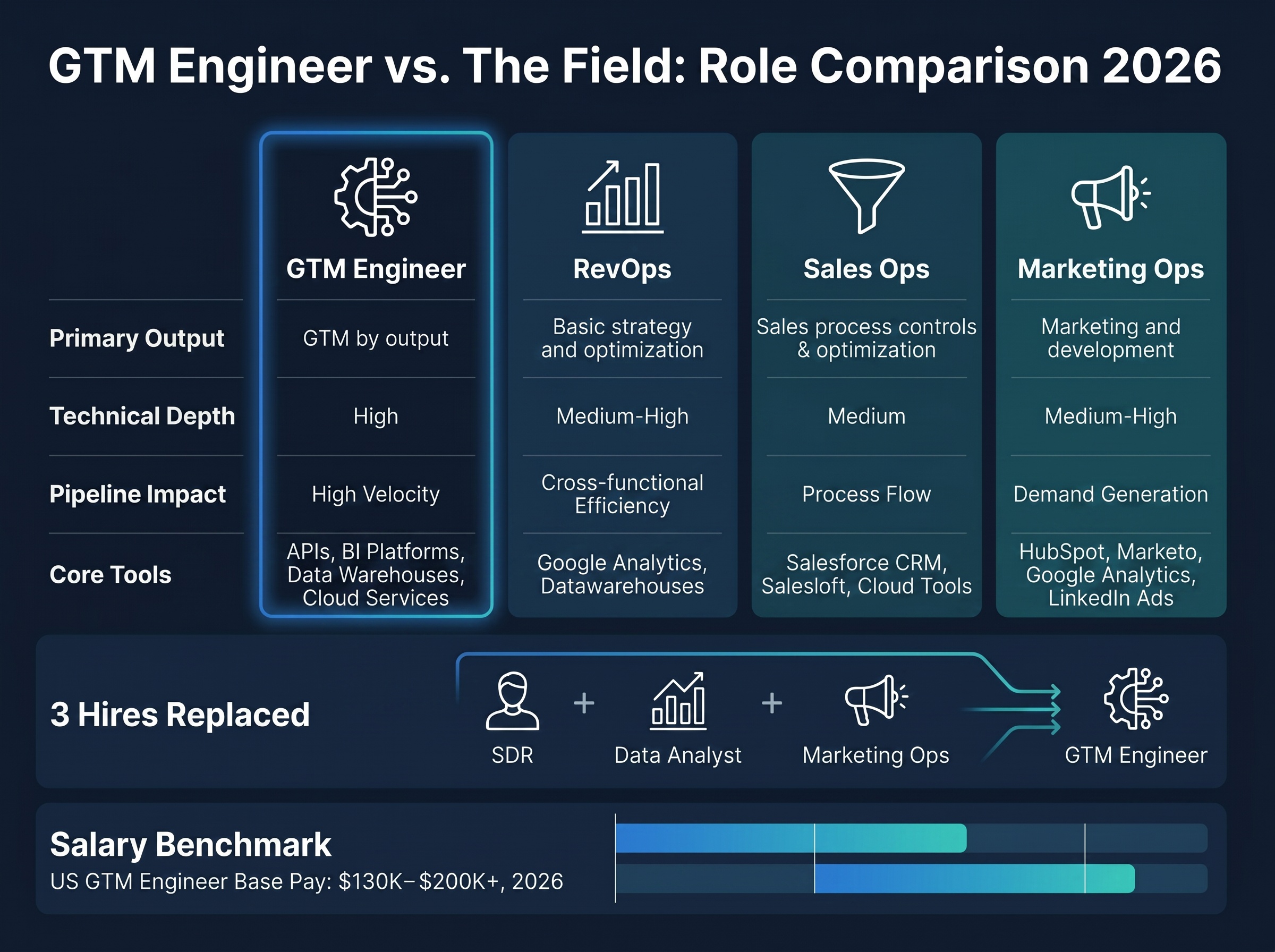
A GTM Engineer designs and builds the automated systems that generate revenue pipeline, including lead enrichment workflows, CRM architecture, outbound sequencing infrastructure, and API integrations across the GTM tech stack. They replace the manual, rep-dependent processes that most sales teams rely on with scalable, data-driven systems. Unlike a Sales Ops analyst who maintains existing processes, a GTM Engineer builds new ones from scratch.
In 2026, US-based GTM Engineers earn between $85K and $200K+ depending on experience level. Junior roles (0–2 years) typically start at $85K–$115K base. Senior GTM Engineers with 5+ years of experience and strong Clay/API fluency command $150K–$200K base, with total compensation often higher due to performance bonuses tied to pipeline outcomes. Fully-loaded annual cost for a senior GTM Engineer at a US-based company typically runs $180K–$220K.
Engineers earning $400,000+ annually are almost always senior or staff-level software engineers at major technology companies (Google, Meta, Apple, Amazon, Stripe, and similar). These figures reflect total compensation packages including base salary, restricted stock units (RSUs), and performance bonuses, not base salary alone. GTM Engineers are not software engineers and are not compensated on this scale; their role is commercial and operational, not software development.
$500,000+ total compensation is typical for principal or distinguished software engineers at FAANG-tier companies, or for engineering managers overseeing large teams at high-valuation tech companies. According to data from Levels.fyi ↗, staff engineers at Google and Meta regularly report total compensation in the $400K–$700K range when stock appreciation is included. This has no direct relevance to GTM Engineer compensation, which operates in a completely different market.
RevOps (Revenue Operations) is a management and alignment function focused on process documentation, reporting, forecasting, and cross-functional coordination. GTM Engineering is a build function focused on creating net-new automation systems and revenue infrastructure. RevOps optimizes what exists; GTM Engineering creates what doesn't. In companies with both, the GTM Engineer builds the systems and the RevOps team monitors and maintains them.
Most SMBs cannot cost-effectively justify a full-time senior GTM Engineer at $180K–$220K fully loaded. The practical alternative is decomposing the GTM Engineering function into component roles: an offshore data analyst managing enrichment and CRM hygiene, offshore SDRs running sequences, and an offshore email marketing specialist managing deliverability infrastructure. This approach delivers equivalent GTM outcomes at roughly 25–35% of the cost of a single senior US hire. See the offshore marketing team roles Remote Growth Partners places for available role types.
The GTM Engineer role is real, the demand is real, and the impact a skilled one can have on your pipeline is real. But for most US-based SMBs and growth-stage companies, a single $180K–$220K hire isn't the right path to GTM engineering outcomes.
What you actually need is the outcome: systems that generate pipeline without being entirely rep-dependent, CRM data that's clean and actionable, enrichment workflows that surface the right leads, and outbound infrastructure that performs consistently.
A coordinated offshore team gets you there. An offshore data analyst who owns your Clay workflows. Offshore SDRs who run your sequences with discipline. An offshore email marketing specialist who manages your deliverability. A fractional strategist (or an internal leader) who owns the architecture.
That's the model. And it's significantly more affordable than posting a GTM Engineer job description and hoping a unicorn applies.
If you're ready to build that team, get started with Remote Growth Partners, or if you're still evaluating your options, read through best sales outsourcing companies in 2026 and questions to ask sales outsourcing companies before signing to make sure you're picking the right partner.
The companies winning on outbound in 2026 aren't the ones with the most SDRs. They're the ones with the best systems. Build the system.
Recruiting, testing, and interviewing the most talented SDRs, designers, video editors, and marketers from overseas.



.jpg)

