Share this post


.svg)
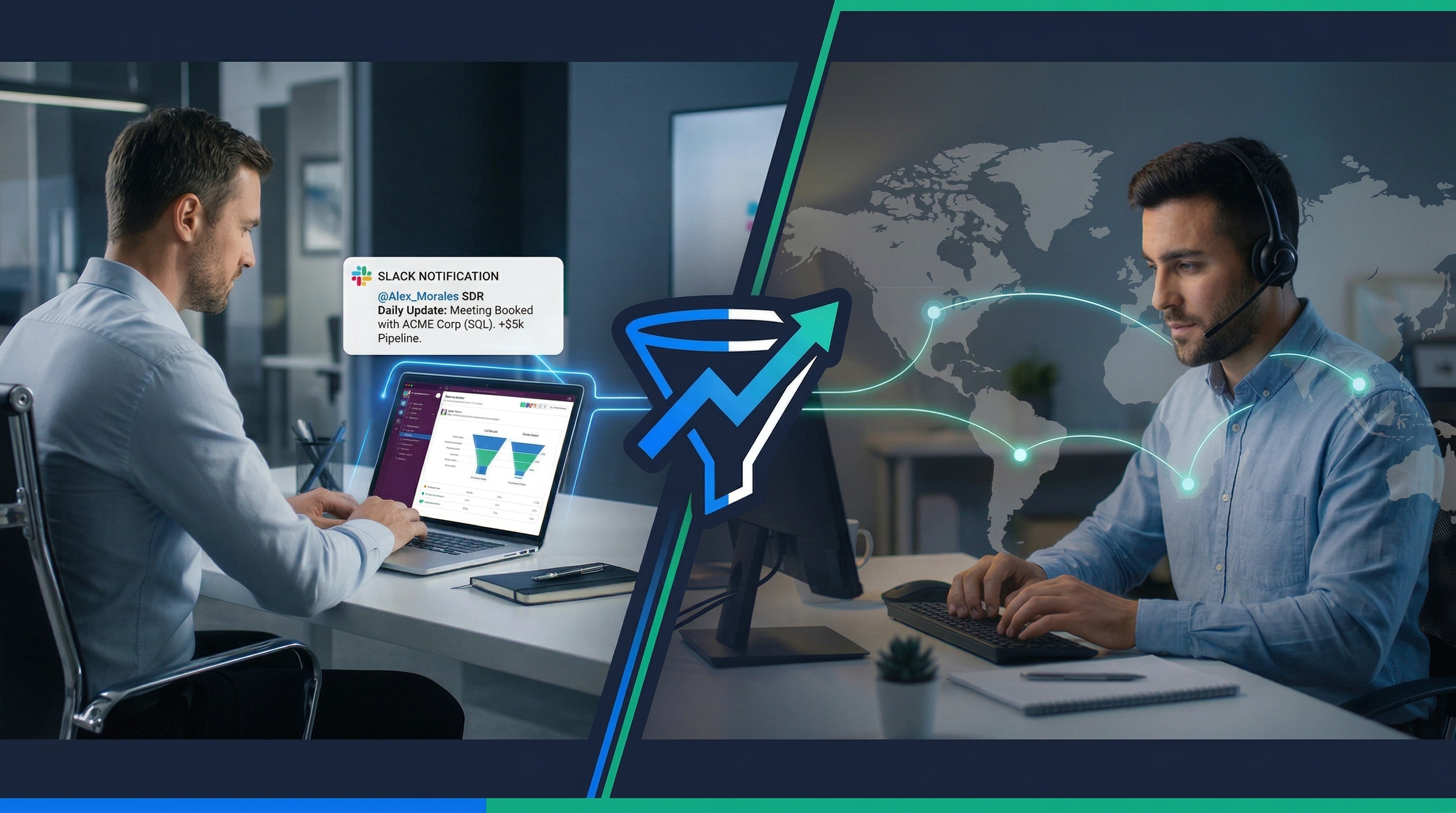
Managing offshore SDRs remotely is not a supervision problem — it is a systems problem. U.S. sales leaders who transplant their domestic management model onto an offshore team without modification consistently underperform. The teams that win in 2026 build asynchronous infrastructure, structured coaching cadences, and AI-powered feedback loops before they ever book their first call review. When the system is right, offshore SDRs in English-fluent markets like the Philippines, Colombia, and South Africa match or exceed domestic output at 50–70% of the cost.
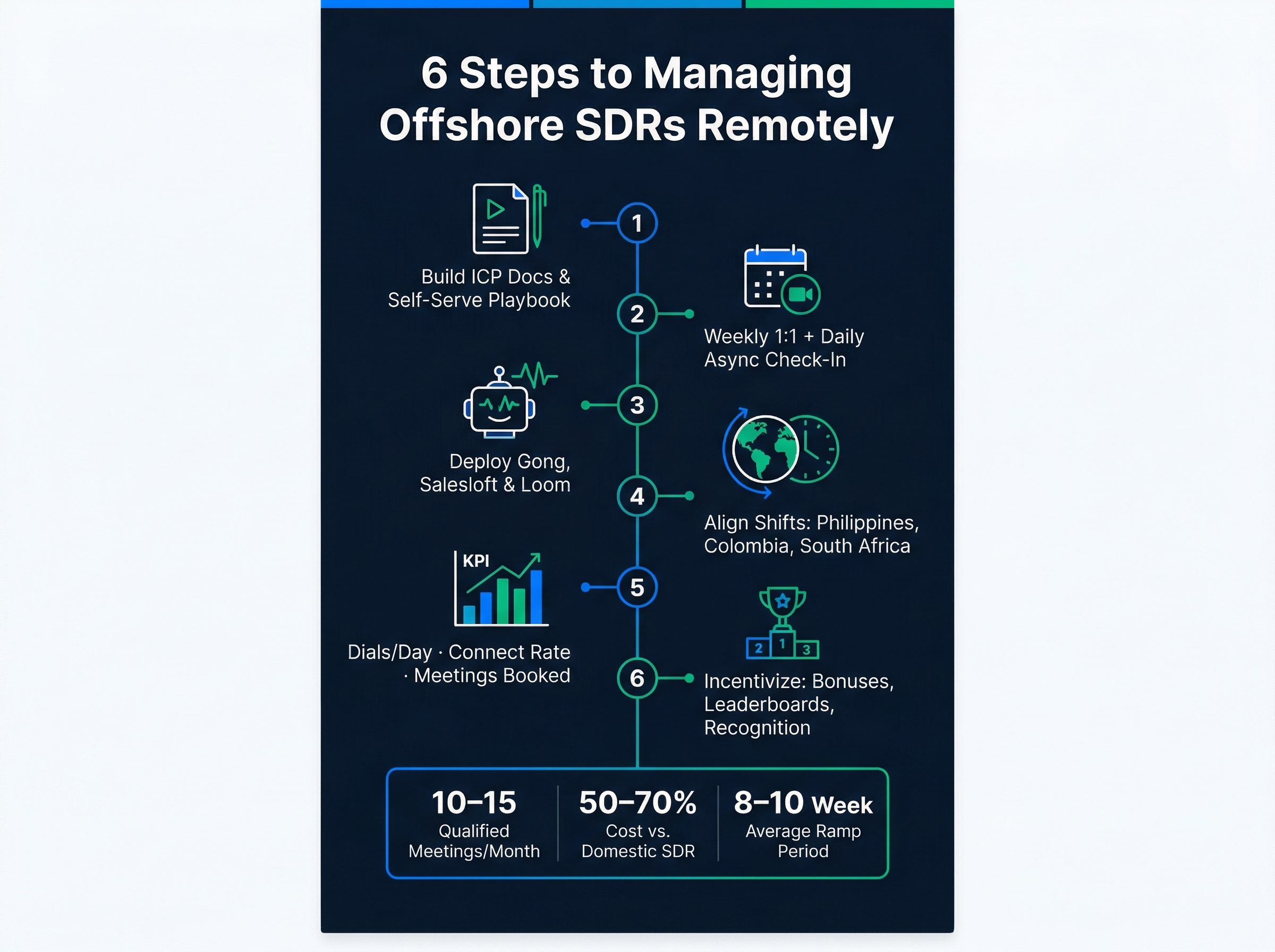
Quick Answer: To manage offshore SDRs remotely, build a self-serve sales playbook and KPI framework before day one, then run a weekly live 1:1, daily async check-ins via Loom or Slack, and monthly performance reviews with scorecards. Use AI call coaching tools like Gong or Chorus to review recordings asynchronously and tie incentives to meetings held — not just meetings booked. This system-first approach is what separates high-output offshore SDR teams from expensive experiments.
Key Takeaways:
- Effective offshore SDR management is built on systems and async infrastructure — not live supervision or replicated domestic frameworks.
- A three-layer coaching cadence (weekly live 1:1, daily async check-in, monthly performance review) maintains accountability without micromanaging.
- AI tools like Gong, Salesloft, Apollo, and Loom make cross-timezone coaching scalable and specific.
- Colombia offers real-time EST overlap; Philippines provides early-morning U.S. coverage; South Africa offers partial overlap — each requires a tailored shift strategy.
- Well-managed offshore SDRs should target 10–15 qualified meetings per month at full quota, with a 2-month ramp period starting at 50%.
Managing offshore SDRs remotely requires a fundamentally different operating model than managing a domestic team down the hall. The core issue is not time zones or language — it is that most sales managers manage by proximity. When proximity is removed, teams that were never given real systems collapse.
In 2026, managing offshore SDRs remotely means building asynchronous operating systems — documented processes, self-serve resources, structured feedback loops, and AI-augmented coaching — that function without a manager in the room. It is management by design, not by presence.
The single most common reason offshore SDR programs fail is launching coaching before the foundation exists. Coaching cannot compensate for missing infrastructure.
Before your offshore SDR sends one email, set written performance standards:
| Metric | Benchmark (2026) | Notes |
|---|---|---|
| Dials per day | 60–80 | Varies by industry and sequence type |
| Emails sent per day | 40–60 | Includes automated touches |
| Connect rate | 8–12% | Of dials resulting in live conversation |
| Meetings booked per month | 10–15 | At full quota, mature sequence |
| Show rate | 70–80% | Meetings held vs. booked |
| Pipeline value generated | Varies by ACV | Set a floor relevant to your deal size |
These benchmarks align with data published by RAIN Group's sales research ↗ and reflect current outbound market conditions in 2026.
A usable playbook is not a slide deck. It is a self-serve operating manual that answers every question a new SDR will ask in their first 30 days. It must include:
This playbook is the prerequisite to effective coaching. Before running your first call review, your SDR needs to have completed the 30-day offshore SDR onboarding playbook — a structured ramp process that links onboarding completion to quota eligibility.
A coaching cadence is not a calendar invite. It is a repeatable system that creates continuous skill development without requiring the manager to be always available.
Run a 30–45 minute live 1:1 every week — no exceptions. Use a standing agenda:
Keep a shared 1:1 doc in Notion or Google Docs. Both manager and SDR add agenda items before the call.
Daily live standups across a 12-hour time zone gap are impractical. Replace them with a structured async check-in:
#sdr-daily-wins) where SDRs post metrics and notable prospect interactionsThis creates a documented coaching record, surfaces patterns faster than weekly meetings alone, and keeps the SDR accountable without surveillance.
Once per month, run a 60-minute structured review:
"The difference between a managed team and a coached team is documentation. Managed teams know what to do. Coached teams know why it works and how to improve." — Common principle among high-performing sales organizations
Your CRM is your source of truth. Without clean data, remote management is guesswork.
Require SDRs to log every touchpoint within 24 hours. Build automated dashboards visible to both SDR and manager.
AI call coaching is the most significant productivity multiplier available to remote SDR managers in 2026. Tools like Gong analyze talk-to-listen ratio, keyword detection, objection frequency, and sentiment — giving managers objective data to replace subjective impressions.
| Tool | Best For | Price Range | Key Feature |
|---|---|---|---|
| Gong | Mid-market to enterprise | $$$ | AI call scoring, deal intelligence |
| Chorus (ZoomInfo) | Enterprise | $$$ | Conversation analytics, CRM sync |
| Salesloft | SMB to enterprise | $$ | Sequencing + call recording in one |
| Apollo.io | SMB and startups | $ | Affordable sequencing + basic analytics |
| Fireflies.ai | Budget teams | $ | AI meeting notes, free tier available |
For small teams, Apollo + Fireflies is a cost-effective stack that covers sequencing, call recording, and AI transcription without enterprise pricing.
Loom is the most effective tool for cross-timezone call coaching. The workflow:
This creates a coaching conversation — not a one-way critique — and is fully asynchronous.
Time zone alignment directly impacts prospect reach and SDR wellbeing. Here is the real-world picture for the top English-fluent markets in 2026:
| Country | Time Zone vs. EST | U.S. Overlap | Best Use Case |
|---|---|---|---|
| Colombia | EST (UTC-5) | Full overlap | Real-time U.S. sales calls, no shift adjustment |
| South Africa | EST+6–7 hrs | 4–5 hrs partial | East Coast morning coverage, early shift |
| Philippines | EST+12–13 hrs | Morning shift only | Requires 9PM–5AM local shift for EST alignment |
| Mexico | EST+0–1 hr | Near-full overlap | Strong for bilingual English/Spanish markets |
| India | EST+10.5 hrs | 3–4 hrs partial | Best for APAC-facing or async-heavy roles |
Colombia is the strongest option for teams that need full EST overlap without shift adjustments. For a deeper breakdown of cost, English proficiency, and hiring availability, see our full guide on best countries to hire offshore SDRs in 2026.
For Philippine-based SDRs targeting U.S. EST prospects:
For SDRs working Colombia or Mexico time zones, standard 8 AM–5 PM local hours align naturally.
According to SHRM research on remote work productivity ↗, asynchronous communication systems reduce meeting fatigue and increase individual contributor output by 18–23% in distributed team environments.
Activity metrics prevent stagnation. Outcome metrics drive decisions.
Generic feedback — "great energy," "work on your close" — is worthless. Effective remote call coaching is specific and timestamp-anchored.
Remote call review process:
"Coaching is most effective when it is specific, immediate, and tied to a single behavior change. Broad feedback produces broad non-improvement." — Principle validated by research from the Harvard Business Review ↗
Focus your call review on:
Offshore SDRs working U.S. time zones with a mature sequence in place should target:
These benchmarks reflect outbound performance data from Bridge Group's SDR research ↗, adjusted for current market conditions.
Culture inclusion starts at day one — not after the ramp period. Offshore SDRs who feel like contractors churn. Those who feel like team members stay, improve, and refer peers.
Immediate inclusion tactics:
Well-managed offshore SDRs in English-fluent markets like Colombia and the Philippines consistently match or exceed domestic SDR output when given equivalent systems, coaching, and tools — at 50–70% of the total cost. This is not a quality trade-off. It is a ROI multiplier.
The highest-output offshore SDR teams share five characteristics:
To see how to find and hire offshore SDRs who are pre-vetted and ready to ramp, explore RGP's talent model. If you want to understand exactly how vetting works before you commit, read how RGP vets and places offshore talent.
You can also explore all offshore roles RGP fills if you are building a broader go-to-market team beyond SDRs.
Before signing with any sales staffing partner, review the questions to ask before signing with a sales outsourcing company — and compare your options against the best sales outsourcing companies in 2026.
Managing offshore SDRs remotely requires an async-first operating model built on documented playbooks, structured coaching cadences, and AI-powered call review tools — not transplanted domestic management frameworks. In 2026, the most effective approach combines a weekly live 1:1, daily Loom or Slack async check-ins, monthly scored performance reviews, and tools like Gong, Apollo, Salesloft, and HubSpot to create visibility across time zones. Offshore SDRs in English-fluent markets — particularly Colombia (full EST overlap), the Philippines (shift-adjusted), and South Africa (partial overlap) — should target 10–15 qualified meetings per month at full quota with a 2-month ramp period. Well-managed offshore SDR teams consistently deliver pipeline results comparable to domestic hires at 50–70% of the cost, making offshore SDR management one of the highest-ROI scaling decisions available to U.S. sales leaders in 2026. The prerequisite to all effective coaching is a self-serve sales playbook and onboarding program that empowers the SDR to operate independently before the first coaching session begins.
One experienced sales manager can effectively coach 6–10 offshore SDRs using an async-first model with AI call scoring tools. Beyond 10, coaching quality degrades without a dedicated SDR team lead or RevOps support. The right ratio depends on ramp stage — managers should carry no more than 4–5 SDRs in active ramp simultaneously.
Yes — when given equivalent systems, playbooks, and coaching. Well-managed offshore SDRs in English-fluent markets (Colombia, Philippines, South Africa) match or exceed domestic SDR output at 50–70% of total cost. The performance gap in underperforming teams is almost always a management systems problem, not a talent problem. See what RGP clients say about their offshore sales teams for real-world performance context.
HubSpot is the most practical choice for teams under 20 SDRs — it is affordable, has strong native reporting, and integrates with Apollo, Salesloft, and Gong. Salesforce is better for enterprise teams that need advanced customization. For early-stage startups with tight budgets, Pipedrive offers a clean pipeline view at lower cost, though its analytics depth is limited.
Establish clear data handling policies in writing before day one. Restrict CRM access to role-appropriate data, use SSO and two-factor authentication on all tools, and run background checks on all hires. For U.S. companies, ensure offshore contractors sign an NDA and data processing agreement aligned with applicable state privacy laws. Work with a staffing partner that conducts pre-placement vetting — how RGP vets and places offshore talent covers this process in detail.
In 2026, a well-supported SDR should make 60–80 dials per day on a blended outbound sequence that includes calls, emails, and LinkedIn touches. Pure cold-call-only models typically require 80–100 dials to achieve the same connect volume. Dial targets should be adjusted based on industry, contact data quality, and sequencing tool capabilities — not set arbitrarily.
A qualified booking rate of 10–15 meetings per month is the 2026 benchmark for a fully ramped offshore SDR running a mature, multi-touch sequence targeting U.S. buyers. Show rate should be 75% or higher. If meetings are booking but not showing, the issue is qualification criteria, not outreach volume — tighten ICP definition and add a pre-meeting confirmation sequence.
If you have read this far, you already know the model. The only remaining question is whether you build it with the right talent foundation.
Remote Growth Partners pre-vets every SDR candidate before placement — checking English fluency, outbound experience, CRM proficiency, and cultural fit for U.S. sales environments. You do not interview 30 candidates. You choose from a shortlist of qualified SDRs who are ready to ramp.
Get started hiring an offshore SDR or schedule a discovery call to walk through your pipeline goals, target market, and the right offshore model for your team size.
The system works. The talent exists. The only variable is whether you build it now or watch a competitor do it first.
Recruiting, testing, and interviewing the most talented SDRs, designers, video editors, and marketers from overseas.




.jpg)