Share this post


.svg)
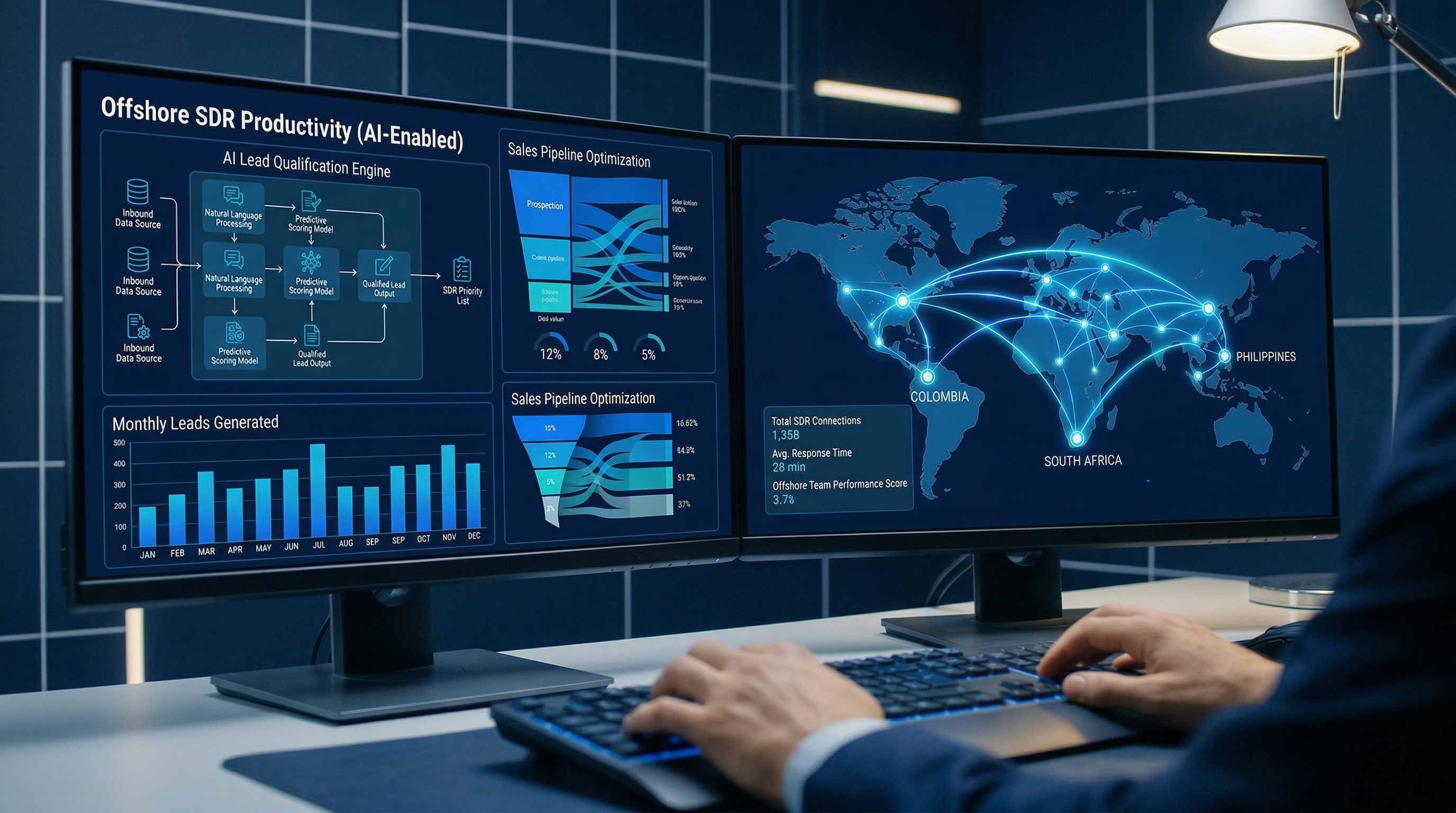
US businesses using offshore SDRs already enjoy a significant labor cost advantage — but without the right AI tools, that advantage is undermined by manual workflows, inconsistent outreach quality, and time zone gaps that slow feedback loops. In 2026, offshore SDR productivity AI tools have become the single most effective lever for closing the performance gap between offshore and in-house sales development teams.
Quick Answer: The fastest way to improve offshore SDR productivity in 2026 is to layer AI tools across five core workflows: prospecting, email personalization, call coaching, CRM automation, and meeting scheduling. Teams using this AI-augmented stack consistently book 30–50% more meetings per SDR per month compared to teams relying on manual processes alone.
Key Takeaways:
- Offshore SDR teams face five specific productivity bottlenecks that AI tools directly address: manual prospecting, CRM data entry, slow feedback loops, tone-calibration in outreach, and delayed follow-ups.
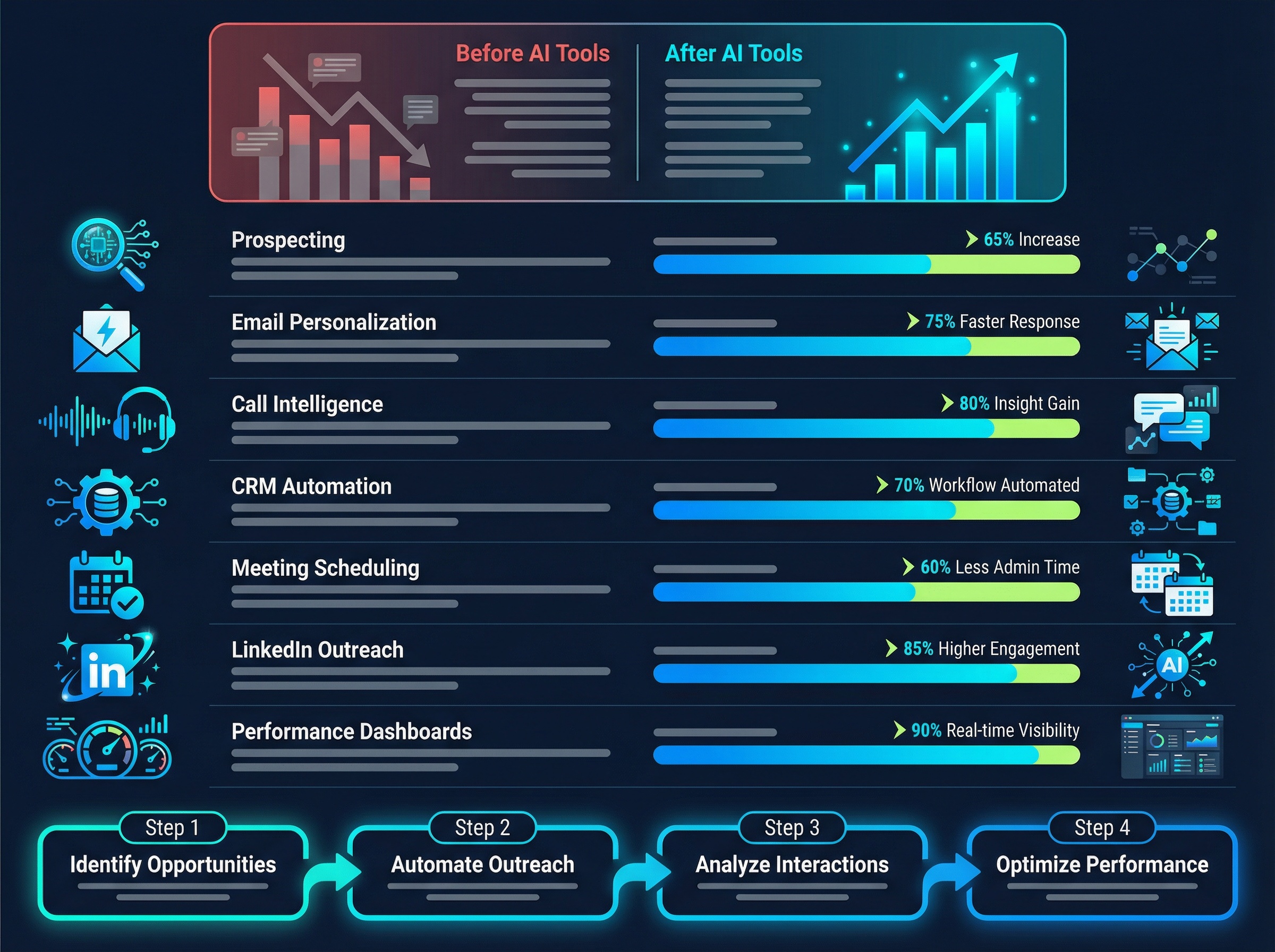
- The 7 highest-impact AI tool categories for offshore SDRs in 2026 include prospecting, email personalization, call coaching, CRM automation, scheduling, LinkedIn outreach, and performance dashboards.
- AI tools combined with offshore labor cost savings (60–70% vs. US-based SDRs) create a "double leverage" ROI effect for US businesses.
- Realistic post-AI benchmarks: 80–120 dials/day, 150+ personalized emails/week, and 12–18 meetings booked per SDR per month.
- The most common rollout mistakes are over-automating outreach, skipping tool training, and choosing platforms without CRM integration.
Offshore SDRs are a proven cost-efficiency play — but productivity gaps persist without deliberate systems. Understanding the root causes is the first step to fixing them.
The business case for offshore sales development is strong. According to LinkedIn's 2025 Global Talent Trends Report ↗, demand for remote sales talent in markets like the Philippines, Colombia, and South Africa has grown more than 40% over the past two years. Yet many US sales managers report that their offshore SDR teams underperform on meetings booked and pipeline generated — not because of talent deficits, but because of process deficits.
If you're evaluating where to source talent, our guide to the best countries to hire offshore SDRs in 2026 breaks down cost, English proficiency, and time zone compatibility by region.
AI tools don't replace skilled offshore SDRs — they remove the low-leverage tasks that consume 40–60% of a rep's working day. A rep freed from manual prospecting and CRM entry has 3–4 extra selling hours per day. At scale, this is the difference between 6 meetings booked per month and 15.
"The teams seeing the best results with offshore SDRs in 2026 aren't just hiring smart — they're building AI-augmented workflows that let offshore reps punch above their weight class on outreach volume and quality."
— Remote Growth Partners, based on client performance data across 50+ offshore SDR placements
Each tool category below addresses a specific bottleneck. Named tools, use-case examples, and integration notes are included so managers can act immediately.
Best tools: Apollo.io, Clay, Lusha
Apollo.io combines a 275M+ contact database with AI-powered lead scoring and sequencing. Offshore SDRs use Apollo to build targeted prospect lists in minutes rather than hours — filtering by company size, industry, job title, and buying signals like recent funding or leadership changes.
Clay takes enrichment further by pulling data from 75+ sources simultaneously and using AI to write personalized first lines based on that enriched data. For an offshore SDR targeting US SaaS companies, Clay can auto-generate a personalized opening sentence referencing a prospect's recent LinkedIn post or company announcement — work that previously took 10–15 minutes per contact.
Use case: A Philippines-based SDR team using Clay reduced list-building time from 3 hours to 25 minutes per session, increasing outreach volume by 220% within the first 30 days.
Best tools: Lavender, Outreach.io, Salesloft
This is the highest-impact category for offshore SDRs. Lavender is an AI email coaching tool that scores email drafts in real time, flagging tone issues, length problems, and low-engagement patterns before the email is sent. For offshore SDRs writing to US-based decision-makers, Lavender's tone guidance is particularly valuable — it flags phrases that read as overly formal, passive, or culturally misaligned.
Outreach.io and Salesloft provide AI-driven sequence optimization, automatically adjusting send times, subject line variants, and follow-up cadences based on engagement data.
According to Lavender's 2025 benchmark data, SDRs who score 90+ on Lavender's email grade achieve a 20.5% reply rate — more than double the industry average of 9.3%.
Use case: An offshore SDR team in Colombia using Lavender increased cold email reply rates from 6% to 14% within 45 days by implementing AI-suggested rewrites on every outbound email.
Best tools: Gong, Orum, Salesloft Conversations
Time zone gaps make live call coaching nearly impossible. Gong solves this by recording, transcribing, and analyzing every sales call — then surfacing AI-generated feedback on talk ratio, objection handling, and next-step clarity. An offshore SDR in Manila finishes their calling block at 2 PM local time; their US manager reviews Gong's AI coaching report at 9 AM EST and leaves asynchronous feedback before the next day's calls.
Orum is an AI-powered parallel dialer that automates voicemail drops, skips disconnected numbers, and connects SDRs only when a human picks up — dramatically increasing live conversations per hour.
Use case: Offshore SDR teams using Orum consistently hit 80–100 dials per day without increasing working hours, compared to 30–40 dials using manual dialing.
Best tools: HubSpot AI features, Salesforce Einstein, Outreach.io
Manual CRM entry is a silent productivity killer. HubSpot's AI call summary feature auto-logs call notes, updates contact properties, and triggers follow-up tasks — removing 45–60 minutes of administrative work per SDR per day. Salesforce Einstein similarly auto-captures activity data and predicts which leads are most likely to convert.
For offshore SDRs, CRM automation also improves data quality — a common complaint from US managers who find that offshore reps enter incomplete records when pressured for time.
Best tools: Chili Piper, HubSpot Meetings, Calendly AI
Chili Piper's AI routing instantly qualifies inbound leads and books meetings without SDR intervention — but its real power for offshore teams is in outbound follow-up. When a prospect replies to a sequence, Chili Piper can automatically route them to the right AE's calendar and send a confirmation, eliminating the back-and-forth that often kills momentum when SDRs are working across time zones.
Best tools: Humanlinker, Dripify, LinkedIn Sales Navigator AI features
Humanlinker uses AI to analyze a prospect's LinkedIn activity, generate hyper-personalized connection requests, and recommend optimal outreach timing. For offshore SDRs who may be less familiar with US professional communication norms on LinkedIn, Humanlinker's AI-generated message templates provide guardrails that improve response rates without requiring constant manager input.
Use case: A South Africa-based SDR using Humanlinker increased LinkedIn connection acceptance rates from 18% to 34% by using AI-generated personalization based on each prospect's recent posts.
Best tools: Gong Forecast, Salesforce Einstein Analytics, HubSpot Reporting
Visibility is the biggest challenge in managing offshore SDRs remotely. AI dashboards aggregate activity data, flag performance anomalies, and surface coaching opportunities without requiring manual report-building. Gong Forecast shows pipeline health in real time; Salesforce Einstein Analytics identifies which SDRs are falling behind on key metrics before the end of the month.
| SDR Task | Best AI Tool | Key Benefit for Offshore Teams |
|---|---|---|
| Lead prospecting & enrichment | Apollo.io, Clay | Replaces 2–3 hrs of manual research daily |
| Email personalization | Lavender, Outreach.io | Tone calibration for US outreach; 2x reply rates |
| Cold calling efficiency | Orum, Gong | 80–100 dials/day; async coaching via recordings |
| CRM data entry | HubSpot AI, Salesforce Einstein | Removes 45–60 min/day of admin work |
| Meeting scheduling | Chili Piper, Calendly AI | Eliminates time-zone follow-up delays |
| LinkedIn outreach | Humanlinker, Dripify | Personalization at scale across profiles |
| Remote performance tracking | Gong Forecast, HubSpot Reporting | Real-time visibility without manual reporting |
Implementing AI tools successfully requires a deliberate rollout sequence. Follow these four steps to avoid the most common mistakes and accelerate time-to-results.
Action: Have each offshore SDR track their time for one week using a simple time-log (Toggl or a shared Google Sheet works fine). Categorize each task: prospecting, writing emails, making calls, logging CRM data, scheduling, and admin. Most teams discover that 40–55% of SDR time is non-selling activity. This audit becomes your AI implementation priority list.
Action: Use the comparison table above to match your top time drains to the appropriate tool category. If email reply rates are the core problem, start with Lavender before investing in a parallel dialer. If CRM hygiene is the issue, start with HubSpot AI automation. Do not try to implement all seven categories simultaneously — focus on one or two tools per 30-day sprint.
Before committing to any tool, review our resource on questions to ask sales outsourcing companies before signing — many of the same due diligence questions apply when evaluating AI tooling vendors.
Action: Allocate 3–5 hours for initial tool training, using recorded Loom walkthroughs so SDRs in different time zones can reference training asynchronously. Establish clear guidelines on AI-generated content: AI drafts outreach copy, but SDRs must review and customize before sending. Over-relying on unreviewed AI output is one of the fastest paths to spam folder placement and brand damage.
Action: Set 30-day, 60-day, and 90-day KPI targets before launch. Baseline metrics to track: dials per day, emails sent per week, reply rate, meetings booked per month, and CRM data completeness score. Review progress in weekly async video updates from SDRs and monthly live performance reviews via Zoom.
AI tools produce measurable, documented performance improvements for offshore SDR teams — but results depend on consistent implementation and proper training.
| Metric | Without AI Tools | With AI Tools | % Improvement |
|---|---|---|---|
| Dials per day | 30–40 | 80–120 | +150–200% |
| Personalized emails per week | 40–60 | 150–200 | +200–250% |
| Cold email reply rate | 5–8% | 12–18% | +100–150% |
| Meetings booked per SDR/month | 5–8 | 12–18 | +100–125% |
| CRM data completeness | 60–70% | 90–95% | +30–35% |
| Non-selling time per day | 3–4 hours | 1–1.5 hours | -60% |
Benchmarks based on aggregated performance data from Remote Growth Partners client teams and published industry studies from Gong's 2025 State of Sales report ↗ and HubSpot's 2025 Sales Trends Report ↗.
Here is where the math becomes compelling. A US-based SDR costs $60,000–$80,000 per year in base salary alone — plus benefits, office overhead, and management time. A pre-vetted offshore SDR in the Philippines or Colombia costs $18,000–$28,000 per year fully loaded, representing a 60–70% labor cost reduction.
The "double leverage" effect: an offshore SDR at 65% lower cost who books 40% more meetings with AI tools delivers roughly 3x the pipeline ROI per dollar spent versus a US-based SDR without AI tools.
When you hire offshore SDRs who are already trained on these AI platforms, the ramp time compresses significantly — and the ROI calculation becomes even more favorable. See how we compare against other options for businesses evaluating offshore sales outsourcing.
Most rollout failures are preventable. Knowing these four mistakes in advance dramatically improves implementation success rates.
Offshore SDR productivity AI tools represent the highest-leverage investment US businesses can make to maximize the ROI of offshore sales development teams in 2026. The seven core AI tool categories — prospecting, email personalization, call intelligence, CRM automation, meeting scheduling, LinkedIn outreach, and performance dashboards — each address a specific bottleneck that suppresses offshore SDR output. Teams that implement this AI-augmented stack consistently achieve 12–18 meetings booked per SDR per month, compared to 5–8 without AI tools. The combination of 60–70% offshore labor cost savings and AI-driven productivity gains creates a measurable "double leverage" ROI effect that makes offshore AI-enabled SDRs significantly more cost-effective than in-house teams. Successful implementation requires a phased rollout, structured training, and a clear benchmarking system to track and sustain performance improvements.
Yes. All major AI sales tools — including Apollo.io, Lavender, Gong, Outreach.io, HubSpot, and Chili Piper — are fully cloud-based and operate identically regardless of where the SDR is located. Licensing is per-seat, and most tools work with standard internet connections available in primary offshore hiring markets like the Philippines, Colombia, and South Africa.
Most teams see measurable improvements within 30–45 days of consistent AI tool adoption. Email reply rates typically improve within the first two weeks as SDRs internalize Lavender-style feedback. Meetings booked per month usually show significant gains by day 45–60, after SDRs have optimized their sequences using engagement data from Outreach.io or Salesloft.
A functional AI tool stack for one offshore SDR typically costs $200–$500 per month, depending on tool selection. Apollo.io starts at $49/user/month; Lavender at $29/user/month; Gong is enterprise-priced but starts around $100–$150/user/month at smaller team sizes. Even at the high end, $500/month in tooling against $1,500–$2,300/month in offshore SDR labor cost represents a 20–25% overhead add-on that typically generates 100%+ improvement in output.
No. AI tools surface data and automate low-value tasks, but they do not replace judgment, strategy, or relationship management. A manager still needs to review AI-generated performance reports, provide strategic feedback on messaging, and maintain team culture and motivation — especially critical for remote offshore teams across time zones. Learn more about how Remote Growth Partners vets offshore talent and structures management support.
The highest-impact tools for meeting booking are Chili Piper (automated scheduling and routing), Outreach.io (AI-optimized sequences), and Orum (parallel dialing for call volume). Combined, these three tools address the three primary levers for meetings booked: outreach volume, reply conversion, and frictionless scheduling.
Offshore SDRs using AI tools consistently outperform fully automated AI SDR software for complex B2B outreach. Fully automated AI SDR tools (like Artisan or 11x) struggle with nuanced objection handling, prospect relationship building, and the creativity required for high-value deal cycles. The optimal model in 2026 is human offshore SDRs augmented by AI tools — not AI replacing human SDRs.
If the AI tool stack above represents the engine, pre-vetted offshore SDR talent is the driver. Remote Growth Partners places SDRs in the Philippines, Colombia, South Africa, and other top offshore markets — screening specifically for English proficiency, sales aptitude, and prior experience with the AI tools described in this article.
Every placement includes our 30-day offshore SDR onboarding playbook, which walks US managers through tool setup, KPI calibration, and the async management rhythms that keep offshore teams performing at a high level without constant oversight. See what our clients say about the results they've achieved.
The combination of our talent vetting rigor and an AI-powered workflow is what separates high-performing offshore SDR teams from the ones that plateau at mediocre output. You're not just hiring a cheaper SDR — you're building a leverage engine that compounds over time.
Ready to build yours? Get started with offshore sales hiring and speak with our team about which AI-ready offshore SDR profile fits your pipeline goals.
Recruiting, testing, and interviewing the most talented SDRs, designers, video editors, and marketers from overseas.



.jpg)