Share this post


.svg)

A video editor recruitment service connects agencies with pre-vetted editing talent, either as freelancers, contract staff, or dedicated full-time hires. Unlike general job boards or freelance marketplaces like Upwork or Fiverr, these services handle sourcing, skills testing, and placement, saving agencies the time and risk of vetting candidates themselves.
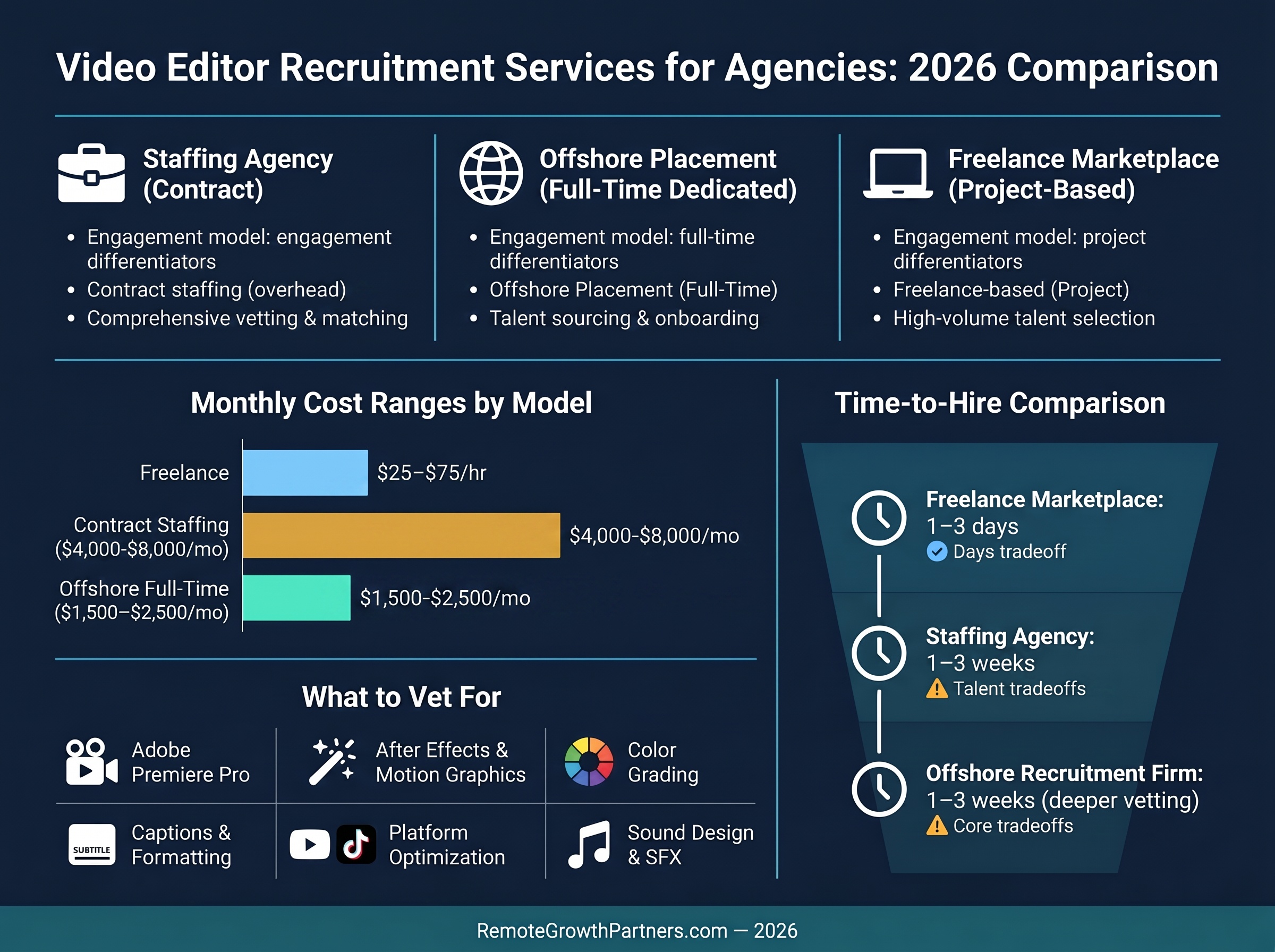
Quick Answer: Video editor recruitment services for agencies source, vet, and place editing talent so you don't have to sift through hundreds of unqualified applicants. The best options for agencies with ongoing volume are offshore placement firms that provide dedicated full-time editors at $1,500–$2,500/month, fully managed, far cheaper than contract staffing agencies or freelance platforms.
Key Takeaways:
- Offshore full-time dedicated editors cost $1,500–$2,500/month all-in, roughly 60–70% less than equivalent U.S. freelance rates
- Vetting quality is the biggest differentiator: the best services use paid real-work tests, not just portfolio reviews
- Motion graphics is a distinct skill from basic editing, your recruitment service should test for it separately
- Time-to-hire ranges from 1–3 days (freelance marketplaces) to 1–3 weeks (offshore recruitment firms with deeper vetting)
- Red flags include shared editors, no paid test assignments, and no account management after placement
Most agencies don't have an HR department. They have a project manager who's also writing briefs, a creative director who's also on client calls, and exactly zero bandwidth to spend two weeks sourcing a video editor.
Video editor recruitment services exist to solve that problem. But not all of them are built the same way.
These three models are often lumped together, but they work very differently:
Staffing agencies fill short-term or contract positions. They're fast but expensive, you're paying a markup on top of the editor's rate, and the talent isn't yours to keep long-term. Works well for a one-off project sprint.
Traditional recruitment agencies handle direct hire. They source candidates, run initial screens, and hand them to you for final interviews. You own the relationship once they're placed. Slower (4–8 weeks is common) and usually involves a placement fee of 15–25% of first-year salary.
Offshore placement firms provide dedicated full-time editors who work exclusively for your agency, not shared across multiple clients. The firm handles payroll, compliance, and account management. Best ROI for agencies producing consistent content volume for YouTube, TikTok, or Instagram Reels.
Three criteria drove the rankings below.
Portfolio reviews are table stakes. The services worth your time give candidates a paid real-work test, actual footage to cut, actual briefs to follow. This is the only reliable way to know if an editor can match your agency's style before day one.
For agencies with recurring video deliverables, a dedicated full-time editor beats a shared freelancer every time. Shared editors split their attention. Your editor should know your clients, your brand voice, and your revision preferences, that institutional knowledge compounds over time.
A great long-form YouTube editor isn't automatically a great short-form TikTok editor. Aspect ratios, caption styles, pacing, hooks, these are legitimately different skills. The best video editor recruitment services vet for platform fit, not just general editing ability.
Remote Growth Partners is an offshore video editor recruitment firm that sources, vets, and manages dedicated full-time editors for marketing agencies. Their offshore video editor placement service is built specifically for agencies producing consistent content volume, not one-off projects.
What sets them apart is their 4-stage vetting process. Candidates are screened on technical skills, then given a paid real-work test using footage that mirrors what they'd actually edit for your agency. Learn exactly how Remote Growth Partners vets offshore video editors before they're placed.
Editors are specialists: YouTube editors focus on retention-optimized cuts and chapter flow; TikTok and Instagram Reels specialists understand hooks, captions, and vertical formatting. All editors work exclusively for one client, no shared talent across accounts.
Payroll, compliance, and ongoing account management are fully managed. You don't deal with contracts, taxes, or HR overhead.
They also have an honest qualification policy: if your agency isn't the right fit (wrong volume, wrong budget, wrong expectations), they'll tell you upfront rather than oversell. See client reviews and testimonials from agencies already placed.
Cost: $1,500–$2,500/month all-in. Time to hire: 1–3 weeks.
Bottom line: The strongest option for agencies that need a dedicated, platform-specific video editor with Fortune 500-level vetting and zero internal HR overhead.
Toptal is a premium freelance marketplace that screens out roughly 97% of applicants before they join the network. For video production staffing, their matching process is genuinely fast, often 48 hours to a candidate introduction.
The limitation for agencies: Toptal editors are freelancers, not dedicated staff. You're renting their time, not building a relationship with a team member. Rates reflect the premium positioning, typically $75–$150/hr for experienced post-production specialists.
Bottom line: Good for urgent, high-stakes project work. Not the right fit if you need a consistent editing workflow.
Somewhere is a generalist offshore staffing platform that places talent across a wide range of roles including video editors, content writers, and virtual assistants. Their model is simple: they source offshore candidates, you handle final selection.
The tradeoff is depth. Somewhere doesn't specialize in video production, which means their vetting for Adobe Premiere Pro, After Effects, or platform-specific editing skills is less rigorous than dedicated video recruitment services.
Bottom line: Useful for agencies building out a broader offshore team at once. For video editing specifically, you'll want to run your own skills tests post-placement.
Hire Overseas positions itself as a fast, affordable offshore staffing solution starting around $2,000/month. Their case studies cover creative, technical, and operational roles, and their social proof is strong for non-video roles.
The gap: no video editing-specific vetting is documented on their site, and no case studies specific to post-production or social media video work exist. They're a reasonable general option but lack the specialization most agencies need when hiring a video editing team.
Bottom line: Worth exploring for cost-conscious agencies, but verify their video-specific vetting process before committing.
Vidchops is a managed editing service (not a recruitment service) where you submit raw footage and receive edited videos on a subscription basis. No hiring, no management, no individual editor assigned to your account.
The appeal is simplicity. The limitation is control, you can't direct an individual editor's development, build brand consistency, or request that one editor learns your client's specific style.
Bottom line: Decent for agencies with simple, high-volume social content needs. Not suitable if quality consistency or client-specific customization matters.
Video Husky offers a managed video editing retainer service, similar to Vidchops. You pay monthly, submit requests, and get edits back. Like Vidchops, it's a service model rather than a talent placement model.
The distinction matters: you're not hiring an editor, you're outsourcing to a team you don't manage. That's fine for commodity editing. It's a problem when clients need distinctive, evolving content.
Bottom line: Solid for straightforward retainer work with light creative requirements.
Belay is a U.S.-based virtual staffing company that matches clients with contractors across executive assistant, bookkeeping, and marketing roles. Their creative talent pool is small by comparison, and video editing isn't a core offering.
Rates are domestic U.S. contractor pricing, which eliminates the cost advantage that makes offshore video editor recruitment services appealing for agencies.
Bottom line: Good for U.S.-based administrative or marketing support. Not the right tool for video production staffing at scale.
Motion (sometimes referenced in the context of the Motion Array / Motion creator community) is worth calling out specifically for agencies that need motion graphics work alongside standard editing. After Effects specialists who can build custom lower thirds, animated intros, and kinetic text are genuinely rare, and most freelance marketplaces mix them in with general editors who can't produce at that level.
If motion graphics is a primary deliverable for your clients, vet specifically for After Effects proficiency through a paid test project, not just a portfolio.
Bottom line: If motion graphics is core to your offer, treat it as a separate technical requirement in any recruitment process, not an assumed skill.
Crew.co connects businesses with freelance creative professionals including video directors, editors, and motion designers. It's a project-based platform: post a job, review candidates, hire for a defined scope.
For agencies with occasional large video production needs, brand films, product launches, this model works well. For ongoing content production, the per-project friction adds up quickly.
Bottom line: Strong for discrete, high-budget production projects. Not built for ongoing agency video workflows.
Working Not Working is an invite-only freelance marketplace focused on senior creative talent. Editors, directors, and motion designers on the platform tend to be experienced, with agency or brand-side backgrounds.
The model is purely freelance: no vetting by the platform beyond the invite filter, no managed compliance, no dedicated relationship. Rates are premium. Best suited for agencies that need experienced creative firepower for a specific campaign.
Bottom line: Great rolodex for campaign-level creative hires. Expensive and unmanaged for recurring content production.
| Service | Engagement Model | Editor Type | Avg Cost Range | Vetting Process | Best For |
|---|---|---|---|---|---|
| Remote Growth Partners | Full-time dedicated | Offshore specialist | $1,500–$2,500/mo | 4-stage + paid real-work test | Agencies with ongoing video volume |
| Toptal | Freelance | Screened freelancer | $75–$150/hr | Top 3% screening | Urgent high-stakes projects |
| Somewhere | Offshore staff | Generalist | $1,200–$2,000/mo | General screening | Agencies building broad offshore teams |
| Hire Overseas | Offshore staff | Generalist | From $2,000/mo | General screening | Cost-focused agencies |
| Vidchops | Subscription service | Managed team | $500–$1,500/mo | N/A (service model) | High-volume simple social content |
| Video Husky | Subscription service | Managed team | $500–$1,200/mo | N/A (service model) | Light retainer editing work |
| Belay | U.S. Contractor | Domestic talent | $35–$65/hr | Basic screening | U.S.-based admin/marketing support |
| Motion | Specialty freelance | After Effects specialist | $50–$100/hr | Portfolio-based | Motion graphics-heavy work |
| Crew.co | Project-based | Freelance creatives | Project rate | Portfolio review | Discrete video production projects |
| Working Not Working | Freelance marketplace | Senior creatives | $75–$150/hr | Invite-only filter | Campaign-level creative hires |
Adobe Premiere Pro is the baseline for professional video editing in 2026. Most clients and agencies run frame.io-integrated review workflows that assume Premiere-native projects. If your editor can't work natively in Premiere, you'll hit friction at every revision cycle.
After Effects is a separate tool with a separate skill ceiling. Basic After Effects users can apply templates. Skilled After Effects editors build original animations, motion graphics, and custom transitions. These are different people. Make sure your video editor recruitment service tests for both independently.
"Editors who list 'Adobe Suite' as a skill but can't build a lower third from scratch in After Effects are not motion graphics editors, they're timeline editors who've opened the app once." — Common feedback from senior post-production directors evaluating junior candidates
Post-production quality lives in the details. B-roll selection requires editorial judgment: choosing footage that visually reinforces the script, not just fills dead air. Color grading requires technical calibration and an eye for brand consistency. Sound design, music selection, SFX layering, audio ducking, is what separates videos that feel professional from those that feel assembled.
When evaluating any video editor recruitment service, ask specifically how they test for these three skills. Portfolio review shows output. A paid test shows process.
Not all editors understand that a YouTube video and a TikTok cut aren't the same deliverable. YouTube favors longer retention arcs, chapter markers, and keyword-relevant titles in the edit. TikTok and Instagram Reels demand hooks in the first 2–3 seconds, vertical 9:16 framing, bold caption styling, and rapid pacing.
CapCut has become a common shortcut tool for caption generation, but professional-grade editors integrate captions into their Premiere or DaVinci Resolve workflow for more control. DaVinci Resolve is also worth noting: some color grading specialists prefer it over Premiere for the Fusion tools and advanced color science.
According to Statista's 2025 video platform data ↗, YouTube has over 2.5 billion monthly logged-in users and TikTok surpassed 1.5 billion. Agencies serving clients on these platforms need editors who understand the algorithmic and format requirements of each, not just editors who know how to export an MP4.
Platform-specific optimization means understanding retention graphs, thumbnail-friendly frames, hook placement, and the technical specs (bitrate, frame rate, aspect ratio) each platform rewards. This is a real differentiator in the editors your recruitment service should be surfacing.
Costs vary significantly by model. Here's how the math works in practice:
Freelance editors (Upwork, Fiverr, marketplaces): $25–$75/hr for mid-level work, $75–$150/hr for senior specialists. At 20 hours/week, that's $2,000–$6,000/month with no guarantee of availability or consistency.
Contract staffing agencies: Add 30–50% overhead to freelance rates to cover agency margin. You're paying for speed and some degree of vetting, but there's no long-term relationship built.
Offshore full-time dedicated editors: $1,500–$2,500/month all-in, including payroll, benefits, compliance, and account management. That's the equivalent of a $18–$30K annual salary, compared to a U.S.-based mid-level editor who costs $55,000–$75,000/year before benefits and overhead.
The cost difference between a U.S.-based contract editor and a fully managed offshore dedicated editor often exceeds $3,000–$4,000 per month. For an agency running 4–6 client accounts, that differential compounds quickly. Use the video savings calculator to run the numbers for your specific situation.
The ROI case for offshore full-time editors isn't just about hourly rates. It's about compounding familiarity. A dedicated editor who works on your accounts every day learns your clients' brand styles, your revision preferences, and your workflow tools. That institutional knowledge cuts revision cycles. It reduces QA time. It means faster delivery.
Latin America talent is particularly strong for time-zone alignment if you're a U.S.-based agency. Editors in Colombia, Mexico, and Argentina operate in Central, Eastern, or Mountain time zones, overlapping with U.S. business hours without requiring async-only workflows. Read more about the best countries for offshore video editors and what region fits your agency's needs.
Watch for these before you sign anything:
The agencies that get the best results from video editor recruitment services do three things before they start:
Check out the interview questions for hiring offshore video editors RGP uses internally, many of these are directly usable in your own evaluation process.
Also worth knowing: how our offshore hiring process works walks through each stage from intake to placement, so you know exactly what to expect before you commit.
Video editor recruitment services for agencies range from freelance marketplaces with minimal vetting to fully managed offshore placement firms that handle compliance, payroll, and ongoing account management. For agencies producing consistent video content on YouTube, TikTok, or Instagram Reels, dedicated offshore video editors at $1,500–$2,500/month represent the strongest ROI. Remote Growth Partners is a video editor recruitment service built specifically for marketing agencies, offering a 4-stage vetting process including a paid real-work test, dedicated full-time editors (not shared), and full compliance management. Key technical skills to vet for include Adobe Premiere Pro, After Effects, color grading, motion graphics, and platform-specific formatting. Red flags to avoid include shared editors, missing paid test assignments, and no post-placement account management.
If you're a video editor looking to attract agency clients, the most effective approach in 2026 is building a niche-specific portfolio, focus on one platform (YouTube, TikTok, or brand video) and show before/after edits rather than just finished pieces. Direct outreach to marketing agencies and video production studios, combined with a presence on LinkedIn and in agency-focused Slack communities, consistently outperforms cold applications on job boards. Offering a paid test edit at a discounted rate removes the biggest friction point for agencies evaluating new talent.
It depends heavily on the model. Freelance editors charge $25–$75/hr for mid-level work on platforms like Upwork. Contract staffing agencies add overhead on top of that. Dedicated offshore full-time editors placed through firms like Remote Growth Partners cost $1,500–$2,500/month all-in, which covers full-time hours, payroll, compliance, and account management. For agencies with ongoing volume, the offshore dedicated model is almost always cheaper than the freelance hourly equivalent. Use the video savings calculator to compare your specific situation.
Most video editor recruitment agencies use applicant tracking systems (ATS) like Greenhouse or Lever for candidate pipeline management. For skills testing, the best firms build custom test workflows using client-provided footage reviewed via Frame.io or Vimeo. Technical assessments often focus on Adobe Premiere Pro and After Effects exports, with DaVinci Resolve becoming more common for color grading roles. According to the Society for Human Resource Management ↗, structured skills tests significantly outperform unstructured interviews for predicting on-the-job performance in technical creative roles.
Getting hired as a video editor through an offshore recruitment service or a traditional marketplace comes down to three things: demonstrable platform-specific skills (show YouTube cuts separately from TikTok cuts), technical proficiency in Adobe Premiere Pro and ideally After Effects, and the ability to pass a paid test assignment under real brief conditions. Agencies prioritize editors who can follow a style guide without constant back-and-forth. If you want to work with U.S. agencies remotely from Latin America, being available during U.S. business hours is a genuine competitive advantage. See all offshore roles we place to understand what skill profiles are in highest demand.
A staffing agency typically provides contract workers on a short-term basis, charging a markup on the editor's hourly rate. An offshore placement firm like Remote Growth Partners recruits and places a dedicated full-time editor who works exclusively for your agency, with payroll and compliance fully managed. The offshore model is structurally different: you get a team member, not a temp. The cost is also fundamentally different, with offshore full-time placements typically costing 60–70% less than equivalent U.S. contract staffing.
Yes, quality depends on vetting, not geography. The top video editor recruitment services for agencies use multi-stage vetting including paid real-work tests, regardless of where the editor is located. Research published by Harvard Business Review ↗ has consistently shown that remote workers in structured environments perform comparably to or better than in-office equivalents. The key is the vetting process and the ongoing management structure: both of which dedicated offshore placement firms are built to provide.
Recruiting, testing, and interviewing the most talented SDRs, designers, video editors, and marketers from overseas.