Share this post


.svg)

A Sales Development Representative (SDR) is one of the most misunderstood roles in B2B sales, and also one of the most expensive to get wrong.
Quick Answer: A sales development representative (SDR) is a top-of-funnel sales role focused on prospecting, outbound outreach, and qualifying leads before passing them to an Account Executive. In 2026, US-based SDRs cost $80,000–$100,000+ per year in total employer costs. Offshore SDRs performing the same functions cost 60–70% less, with no meaningful drop in output quality when hired through a rigorous vetting process.
Key Takeaways:
- An SDR's core job is to fill the pipeline, not close deals. They prospect, qualify, and book meetings for Account Executives.
- The full cost of a US-based SDR in 2026 exceeds $100,000 per year when you factor in benefits, payroll taxes, recruiting fees, and ramp time.
- Offshore SDRs in Latin America and the Philippines work full US business hours and use the same tools (Salesforce, Salesloft, LinkedIn Sales Navigator) as their US counterparts.
- The average SDR tenure is under 18 months, meaning you're absorbing ramp costs repeatedly.
- Remote Growth Partners places full-time, exclusive offshore SDRs through a 4-stage vetting process that includes a paid real work test against a live prospect list.
A Sales Development Representative (SDR) is an entry-level to mid-level sales professional responsible for prospecting new business, qualifying inbound and outbound leads, and booking discovery meetings for Account Executives. SDRs sit at the top of the sales funnel, before any demos or proposals happen. They typically report to a VP of Sales or Sales Manager, work daily inside a CRM like Salesforce, and use sales engagement platforms like Salesloft or Outreach to run structured outreach sequences. Their primary output is qualified pipeline, not closed revenue.
This trips up a lot of companies hiring their first sales person. Here's the short version:
The account executive handoff is the critical moment where SDR work is judged. A good SDR doesn't just book meetings, they book the right meetings, with prospects who fit the ICP and have a genuine reason to talk.
Most of an SDR's day is building and working through prospect lists. That means identifying target accounts (usually with LinkedIn Sales Navigator), pulling contact data, and running multi-touch outbound sequences across email, phone, and LinkedIn. A well-run SDR will typically work through 40–80 accounts per week, touching each one 6–10 times across channels before marking them as unresponsive.
Pipeline generation is the metric that matters. Monthly targets and quotas for SDRs are usually set around meetings booked and qualified opportunities created, not dials made, though dials are tracked too.
Not all SDRs are purely outbound. Many companies route marketing-generated leads, website forms, content downloads, webinar signups, to SDRs for qualification. The SDR's job here is to respond quickly (speed-to-lead matters enormously), run a qualification call, and determine if the prospect is worth an AE's time.
According to research published by Harvard Business Review ↗, companies that respond to leads within an hour are 7x more likely to have a meaningful conversation than those that wait even 2 hours. SDRs are the frontline of that response.
This is where understanding the buyer's journey matters. An SDR needs to assess where the prospect is in their decision process, what triggered their interest, and whether they have the budget, authority, and timeline to be a real opportunity.
Every interaction gets logged. SDRs are responsible for keeping CRM records clean, updating contact details, logging call outcomes, setting follow-up tasks, and tagging leads with the right status. Poor CRM hygiene at the SDR level creates blind spots for AEs and makes pipeline reporting unreliable.
Salesforce is the dominant CRM most enterprise and mid-market teams use. Smaller SMBs often run HubSpot. Either way, this is daily work, not optional administrative overhead.
Manually sending 80 personalized emails a day isn't realistic. That's what sales engagement platforms are for. Salesloft, Outreach, and Apollo let SDRs build and automate multi-step sequences, track open and reply rates, and manage their daily task queue. These tools also give managers visibility into what's working, which subject lines, which call scripts, which sequences are producing meetings.
A competent SDR in 2026 is expected to be proficient with at least one of these platforms from day one or learn it within the first two weeks.
Salesforce remains the standard for any B2B sales team above 10 people. SDRs use it to log activity, track lead status, manage contact records, and report on pipeline contribution. Even if a company uses HubSpot or Pipedrive, the SDR's fluency with CRM workflows is a core competency, not a nice-to-have.
LinkedIn Sales Navigator is the primary prospecting tool for most B2B SDRs. It lets them filter by industry, company size, title, geography, and dozens of other variables to build targeted account lists. SDRs use it daily to find new contacts, monitor account signals (like job changes or funding rounds), and send InMail when email isn't getting traction.
Each platform has its strengths. Salesloft is strong on call coaching and revenue intelligence. Outreach has deep sequence automation and analytics. Apollo is popular with smaller teams because it combines prospecting data with engagement in one tool at a lower price point.
The 2025 State of Sales report from Salesforce ↗ found that high-performing sales teams are 3.2x more likely to use AI-assisted outreach tools than underperforming teams. In 2026, AI-assisted prospecting is a core part of the SDR workflow, not an experimental feature.
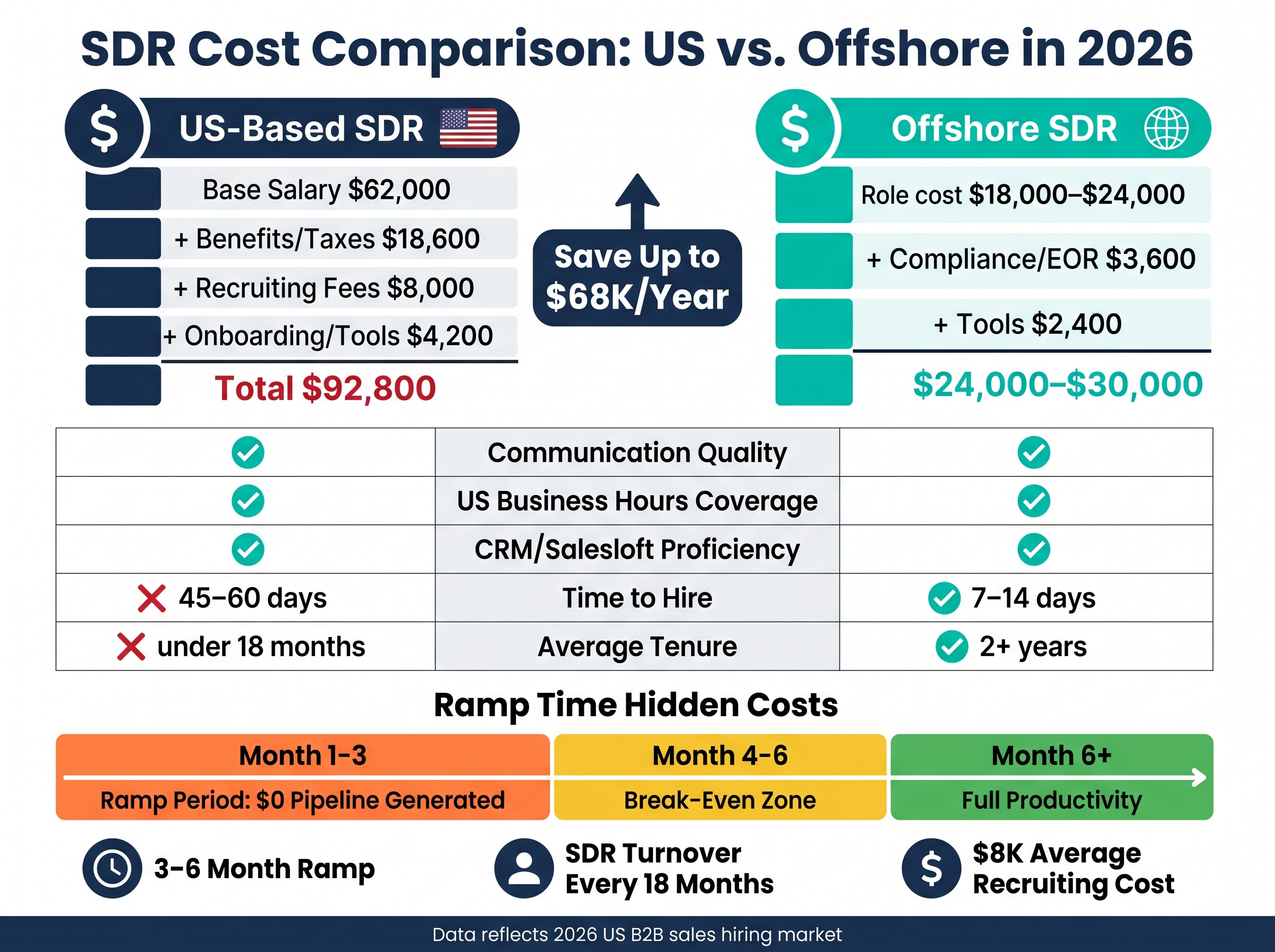
The average base salary for a US-based SDR in 2026 is approximately $62,000 per year, according to data aggregated from Glassdoor, LinkedIn, and industry benchmarks. With commissions and bonuses, on-target earnings (OTE) typically land between $80,000 and $90,000 for a mid-performing rep.
But that's just the W-2 number. The full employer cost is higher:
| Cost Component | Estimated Annual Amount |
|---|---|
| Base salary | $62,000 |
| Commissions and bonuses (OTE) | $18,000–$25,000 |
| Employer payroll taxes (~8%) | $6,400 |
| Health benefits | $6,000–$10,000 |
| Tools and software (Nav, SEP, CRM) | $4,000–$8,000 |
| Recruiting fees (1x if agency) | $12,000–$18,000 |
| Total first-year cost | $108,000–$129,000 |
That's before factoring in manager time spent coaching, onboarding, and dealing with performance issues.
A new SDR rarely hits quota in month one. The industry standard ramp period is 3 to 6 months. During that window, the company is paying full salary for partial output. If the rep takes 4 months to ramp and then leaves at month 14, you've had about 10 months of productive work out of a $120,000+ investment.
That math is brutal for small teams.
The average SDR tenure is under 18 months. Salesforce's own SDR research ↗ and industry reports consistently show high churn in the role, SDRs are promoted, poached, or burned out faster than almost any other sales position. When an SDR leaves, you absorb recruiting fees again, lose pipeline momentum, and restart the ramp clock.
"The hidden cost of SDR turnover isn't just the recruiting fee, it's the 4–6 months of lost pipeline while you find, hire, and ramp the next person."
This turnover cycle is one of the biggest reasons companies are reconsidering the all-US-in-house SDR model.
| Factor | US-Based SDR | Offshore SDR (Latin America / Philippines) |
|---|---|---|
| Base salary | ~$62,000/yr | ~$18,000–$28,000/yr |
| Total employer cost (Year 1) | $108,000–$129,000 | $30,000–$45,000 |
| Ramp time | 3–6 months | 3–5 months (same tools, same process) |
| Working hours | US business hours | Full US hours available |
| CRM/SEP proficiency | Varies | Vetted for Salesforce, Salesloft, Apollo |
| Average tenure | Under 18 months | Often longer (lower market churn) |
| Recruiting cost if they leave | $12,000–$18,000 | Lower, handled by RGP |
The cost difference is real. A company that replaces a US-based SDR with an offshore SDR saves $60,000–$80,000 in year one. Over three years, that's enough to hire a second offshore SDR and still come out ahead.
Offshore SDRs run outbound sequences on Salesloft. They prospect on LinkedIn Sales Navigator. They log calls in Salesforce. They book meetings, send follow-ups, and hit monthly targets just like their US counterparts.
The work is the same. The cost isn't.
If you want to see which markets produce the best offshore SDR talent, the best countries to hire offshore SDRs in 2026 guide covers regional breakdowns across cost, English proficiency, and time zone fit.
This is one of the most common objections, and it's based on outdated assumptions.
Latin American SDRs (Colombia, Mexico, Argentina) operate in time zones that overlap directly with US Eastern and Central business hours. Philippine-based SDRs can shift their working hours to match US mornings and early afternoons. In practice, many clients report that their offshore SDR is online and responsive from 8 AM to 5 PM EST, the same as a US-based rep.
Time zone is a solvable problem. It's not a reason to pay three times more.
"They won't communicate well." Wrong assumption. Top offshore SDR candidates in Latin America and the Philippines have professional-level English, often with neutral accents, and strong written communication. Remote Growth Partners screens specifically for verbal and written communication quality in the first round.
"They can't handle cold calls." Many offshore SDRs have years of cold calling experience for US and UK clients. The skill is the same regardless of where the rep is located.
"Output quality will be lower." Output depends on the quality of the vetting process, not the country of origin. A rigorously vetted offshore SDR outperforms a poorly hired US-based SDR every time.
Most offshore staffing companies send you a resume and wish you luck. Remote Growth Partners runs a 4-stage process designed specifically for sales roles:
You can learn more about how Remote Growth Partners vets candidates in detail before committing to anything.
This isn't a shared outsourced sales vendor where your "SDR" is juggling six other clients. The offshore SDR placed by Remote Growth Partners works for one company: yours. Full-time. Exclusive.
That matters because SDR performance depends on deep product knowledge, brand familiarity, and the kind of rapport that builds over time with an AE team. A shared rep never develops any of that.
Hiring someone in the Philippines or Colombia directly is a legal and administrative headache most US companies aren't equipped to manage. Remote Growth Partners handles it. They operate as the employer of record, managing local contracts, payroll, taxes, and benefits in the employee's home country. The client gets all the benefits of a full-time team member with none of the cross-border HR complexity.
Not every company is ready to make this move. Here's a practical checklist:
If most of those are true, you're ready. If you're still figuring out your ICP and messaging, build that first, an SDR of any kind will struggle without it.
To see the full range of offshore roles we place, Remote Growth Partners also places BDRs, Account Executives, and marketing staff for US-based teams.
Onboarding an offshore SDR follows the same logic as any remote hire, with a few additions. You need to be deliberate about async documentation, CRM access setup, and early quick-win targets. The first 30 days are critical.
The 30-day offshore SDR onboarding playbook covers the exact framework Remote Growth Partners recommends to clients, including daily check-in structure, week-by-week ramp expectations, and how to set quotas for a new offshore hire without setting them up to fail.
A sales development representative (SDR) is a top-of-funnel sales role responsible for outbound prospecting, lead qualification, and booking meetings for Account Executives using tools like Salesforce, LinkedIn Sales Navigator, and Salesloft. In 2026, the total first-year cost of a US-based SDR exceeds $100,000 when employer taxes, benefits, recruiting fees, and ramp time are included. Offshore SDRs in Latin America and the Philippines perform the same core functions at 60–70% lower cost, with full US business hour availability and proficiency in the same sales tech stack. The average US SDR tenure is under 18 months, making turnover costs a recurring expense that compounds the ROI case for offshore alternatives. Remote Growth Partners places full-time, exclusive offshore SDRs through a 4-stage vetting process, including a paid real work test, and handles all employer-of-record and payroll compliance on behalf of US clients.
A sales development representative prospects for new business, qualifies inbound and outbound leads, and books discovery meetings for Account Executives. Day-to-day work includes building prospect lists, running email and phone outreach sequences, logging activity in a CRM like Salesforce, and hitting monthly quotas for meetings booked and pipeline generated. SDRs do not close deals, that's the AE's job.
At the entry level, no, SDR compensation is solid but not high-earning. US-based SDRs earn a base salary of around $62,000 in 2026, with on-target earnings (OTE) reaching $80,000–$90,000 including commissions and bonuses. The role is typically seen as a 12–24 month stepping stone toward an Account Executive position, where earning potential is significantly higher.
In the US in 2026, SDR base salaries average around $62,000 per year, according to Glassdoor ↗ and LinkedIn compensation data. Total OTE with commissions lands between $80,000 and $90,000 for a mid-performing rep. Offshore SDRs in Latin America or the Philippines performing the same role typically earn $18,000–$28,000 per year in their local market, a significant cost difference for US-based employers.
Yes, for people who want to get into B2B sales. The SDR role is one of the most accessible entry points into a sales career, many companies, including those offering the Salesforce Sales Development Representative Professional Certificate ↗, have built structured training programs around it. Most AEs and Sales Managers started as SDRs. The skills developed, objection handling, pipeline discipline, CRM fluency, outreach strategy, are directly transferable and in high demand.
The core job is identical: prospect, qualify, book meetings. The difference is cost and location. Offshore SDRs work full US business hours, use the same tools, and operate under the same KPIs. The savings come from regional salary differences, not from reduced expectations or lower standards. When hired through a rigorous vetting process, offshore SDRs deliver comparable pipeline output at a fraction of the cost.
When you have a defined ICP, a working sales playbook, and at least one AE with capacity to run the meetings an SDR will book. If you've already hired a US-based SDR, experienced turnover, and absorbed the restart costs, that's often the trigger moment. The best sales outsourcing companies in 2026 comparison covers how to evaluate your options before committing to any vendor.
Recruiting, testing, and interviewing the most talented SDRs, designers, video editors, and marketers from overseas.