Share this post


.svg)

Domestic SDR hiring costs are breaking budgets. Base salaries have climbed to $50,000–$65,000 before you add benefits, payroll taxes, recruiting fees, and the three to four months of ramp time where the rep produces little. For early-stage companies and lean sales teams, that math simply doesn't work anymore.
There's a better model. An offshore sales development representative gives you a full-time, dedicated employee who handles outbound prospecting, cold outreach, and meeting-setting, at roughly a third of what the equivalent domestic hire costs. No shared rep pools. No agency markups eating your pipeline ROI. Just a single person, working exclusively for your company, integrated into your CRM and sales cadence like any other team member.
Quick Answer: An offshore sales development representative is a full-time, dedicated remote employee based outside the US who performs outbound prospecting, cold outreach, and meeting-setting for US B2B companies. Offshore SDRs typically cost $25,000–$45,000 per year all-in, compared to $80,000–$110,000 for a domestic in-house SDR, a savings of $40,000 or more annually with no sacrifice in performance when properly vetted and onboarded.
Key Takeaways:
- Offshore SDRs cost $25,000–$45,000/year all-in versus $80,000–$110,000 for a domestic hire
- Full-time dedicated offshore reps consistently outperform shared-rep outsourced agencies
- Top markets for English-fluent offshore SDRs include the Philippines, Colombia, and South Africa
- Proper vetting (including paid real-work tests) eliminates most of the hiring risk
- Companies working with Remote Growth Partners save $40,000+ annually while maintaining pipeline quality
An offshore sales development representative is a full-time, dedicated remote employee based outside the United States who performs the core outbound prospecting functions of a domestic SDR: researching target accounts, running cold email and LinkedIn outreach sequences, making cold calls, qualifying inbound leads, and booking discovery calls for Account Executives.
The critical word here is dedicated. An offshore SDR works exclusively for one company, your company. They're not cycling through three client accounts at 4 PM on a Wednesday. They're not a contractor who logs on when they feel like it. They're a full-time employee on a fixed schedule, aligned to your US business hours, logging into your Salesforce or HubSpot instance, running your cadences in Apollo or Outreach, and attending your Monday standups.
This is the model that companies working with Remote Growth Partners are using to build pipeline at a fraction of domestic cost, and it's worth being very precise about what it is, because the market is full of lookalikes that aren't the same thing.
Three models get lumped together under "sales outsourcing" and they could not be more different in practice.
A freelancer from Upwork or Fiverr is a contractor working project-to-project. They might take on five clients simultaneously, they have no accountability to your process, and "sales development" on their profile could mean anything from cold email copywriting to running mass spam campaigns.
An outsourced SDR agency (SDR-as-a-service) assigns a rep, often shared across multiple clients, to work your account for a few hours per week bundled inside a $5,000–$12,000/month retainer. The rep's first loyalty is to the agency. They rotate campaigns constantly. You're never their priority account.
A full-time offshore SDR through a firm like Remote Growth Partners is none of these. The rep is vetted, placed, and managed as a dedicated employee of your company. They report to you. They build institutional knowledge of your ICP over months and years. The economics, the focus, and the output are fundamentally different.
The offshore SDR role typically covers outbound-heavy prospecting functions: cold calling, cold email, LinkedIn outreach, CRM data entry, lead list building, and meeting scheduling. Some offshore SDRs also cover BDR (Business Development Representative) functions, which often include a slightly broader scope, researching partnership opportunities, outbound into new verticals, or working larger named accounts.
It's worth knowing the distinction: SDRs typically focus on outbound to generate new pipeline, while BDRs often straddle both inbound qualification and strategic outbound. In practice, offshore reps can fill either seat. Many RGP clients also hire offshore Account Executives for later-stage selling on smaller deal sizes, though the SDR and BDR functions are where the offshore model delivers the sharpest ROI.
Most hiring managers budget for base salary and stop there. That's how you end up surprised by the true all-in cost of a domestic SDR, which, once you add every real line item, lands well above the headline compensation figure.
The average SDR base salary in 2026 sits between $50,000 and $65,000 depending on market and industry, according to compensation data from LinkedIn's 2026 Workforce Report ↗. Total on-target earnings (OTE) typically run $70,000–$90,000 when you factor in commission.
On top of OTE, add:
Before you even get to recruiting, you're already well past the base salary figure.
When you add it all together honestly:
| Cost Component | Annual Estimate |
|---|---|
| Base salary | $50,000–$65,000 |
| Commission / OTE gap | $8,000–$20,000 |
| Payroll taxes | $4,000–$6,500 |
| Health and benefits | $7,000–$12,500 |
| Recruiting fee (amortized) | $7,500–$16,250 |
| Ramp cost (productivity loss) | $5,000–$15,000 |
| Software and tooling | $3,000–$6,000 |
| Total all-in | $84,500–$141,250 |
The working estimate most budget planners use is $80,000–$110,000 for a domestic in-house SDR once you strip out the outlier figures. And that's a conservative range.
An offshore SDR typically costs $25,000–$45,000 per year all-in, compared to $80,000–$110,000 for a domestic in-house SDR. US companies working with a managed offshore recruiting partner like Remote Growth Partners save $40,000 or more annually without sacrificing performance.
Monthly all-in costs for an offshore SDR placed through RGP typically break down as follows:
Total monthly: $2,000–$4,200/month, or roughly $24,000–$50,400 annually. Even at the high end, you're below the floor of a domestic SDR's base salary alone.
"The salary arbitrage is real, but the bigger open is the vetting quality. We reviewed 1,100 candidates for a recent SDR placement and presented three finalists. The client hired in under two weeks and the rep booked the first meeting in week three of onboarding." — Remote Growth Partners team
RGP clients routinely save $40,000–$70,000 per year compared to the equivalent domestic hire. On a two-rep offshore SDR team, that's $80,000–$140,000 in annual payroll savings that can be redeployed toward product, marketing, or additional headcount.
To see how this math applies to your current sales budget, explore all offshore roles RGP hires and compare against your existing compensation structure.
| Category | In-House SDR | Offshore SDR via RGP | Outsourced SDR Agency |
|---|---|---|---|
| Annual cost | $80,000–$110,000 | $25,000–$45,000 | $60,000–$144,000 ($5K–$12K/mo) |
| Dedicated or shared | Dedicated | Dedicated | Shared across clients |
| Time to hire | 6–12 weeks | 2–4 weeks | 1–2 weeks |
| Vetting depth | Varies by recruiter | 1,000+ candidates, 4-stage process | Agency-dependent |
| Compliance handled | Employer handles | RGP handles all | Agency handles |
| Language/cultural fit | Native US | High (Philippines, Colombia, SA) | Varies |
| CRM/tool integration | Full | Full | Partial / limited |
| Rep works exclusively for you | Yes | Yes | No |
| Cancellation flexibility | 2+ weeks notice + severance | Structured offboarding | 30–90 day contract lock |
| Replacement if not a fit | You restart from scratch | RGP manages replacement | Agency assigns new rep |
Key Takeaway: For cost, dedicated focus, and vetting quality combined, offshore SDRs via RGP outperform both domestic hiring and outsourced agencies by a significant margin. The agency model costs nearly as much as domestic hiring when annualized, with none of the rep dedication.
Each of the three major sales development models works for a specific company profile. The mistake most teams make is defaulting to the model they know rather than the one that fits their actual situation.
Pros:
Cons:
For early validation or a one-time campaign burst, agencies can work. For sustained pipeline generation, the economics and output quality fall apart fast.
Pros:
Cons:
In-house makes sense when you have the budget, when the SDR role feeds into a promotion path (SDR to AE), and when your deal size justifies the fully-loaded cost. For companies with ACV below $15,000 or early-stage teams under 15 people, the math rarely pencils.
Pros:
Cons:
The cons are all manageable. The 30-day offshore SDR onboarding playbook from Remote Growth Partners addresses each of them systematically.
Key Takeaway: In 2026, offshore SDRs hit the sweet spot between cost efficiency and dedicated performance. Most US B2B companies in the $1M–$20M revenue range get more pipeline per dollar from a dedicated offshore SDR than from either a domestic hire or an agency retainer.
The offshore SDR model isn't just cheaper. In most metrics that actually matter for pipeline generation, a properly placed offshore SDR beats a shared agency rep. Here's why.
The Philippines and Colombia in particular have produced exceptional English-fluent sales talent. Filipino SDRs have neutral accents shaped by decades of US business process outsourcing at scale, a strong culture of professionalism in client-facing roles, and familiarity with US business norms. Colombian SDRs bring strong English fluency, high cultural proximity to US communication styles, and an increasingly sophisticated B2B sales training ecosystem.
South African SDRs are another strong option, native or near-native English speakers with a Western business culture and time zone coverage that overlaps well with US East Coast hours.
To see how these markets compare on cost, English fluency, and time zone fit, read about the best countries to hire offshore SDRs in 2026.
A common objection: "But they're in a different time zone." The reality is that offshore SDRs in the Philippines, Colombia, and South Africa can all work US business hours. Colombian reps are in the same or adjacent time zone (ET/CT). Filipino reps routinely work night shifts aligned to US hours, this is an established professional norm in the Philippines, not an anomaly. South African reps in the ET or PT equivalent window can cover the full US business day.
Cold calling works. These reps are on the phone with US prospects during US business hours. That's the whole point.
Outbound sales is a volume game with a consistency premium. You need reps sending 40–80 targeted outreach touches per day, every day, on a schedule. Freelancers and agency reps can't sustain that for your account because their attention is elsewhere. A full-time offshore SDR builds rhythm, builds confidence in your messaging, and refines their approach based on daily feedback from real conversations.
That consistency is what fills pipelines. It's not complicated, it's just hard to get from a shared resource.
Offshore SDRs placed through RGP are trained to integrate with common B2B sales tools: Salesforce, HubSpot, Apollo, Outreach, LinkedIn Sales Navigator, ZoomInfo, and others. They're not starting from zero on tooling. And because they're dedicated to your account, they can be fully embedded in your CRM workflows, Slack channels, and meeting cadences like any other team member.
Agency reps, by contrast, often work inside the agency's proprietary platforms and feed you exports, which means you're never seeing the full picture of what's happening with your outreach.
Key Takeaway: Dedicated focus, language fluency, US-hours availability, and full tool integration are the four operational advantages that make offshore SDRs outperform shared agency reps on almost every measurable output metric.
Hiring offshore SDRs without a rigorous process is how companies end up with reps who can't communicate clearly, don't understand the product, or disappear after 60 days. The vetting process is everything.
Remote Growth Partners reviews 1,000+ candidates per role before presenting a shortlist to clients. That's not a rounding number, it reflects the volume of applicants sourced, screened, and eliminated through a four-stage process built to find the top fraction of available talent.
Here's how RGP's vetting process works:
Most hiring processes show you resumes, references, and interview performance. Those inputs all have well-documented biases toward people who interview well rather than people who execute well. A paid real-work test inverts the evaluation: you see actual output before you make a hiring decision.
"The paid work test is the filter everything else is building toward. By the time a candidate completes it, we've seen their written communication, their research approach, their sales instincts, and their ability to stay organized under a deadline. That's more signal than five rounds of interviews." — Remote Growth Partners
RGP pays candidates for this test because it signals that both sides are taking the process seriously, and it attracts higher-caliber candidates who are willing to invest time in a thorough process.
When evaluating offshore SDR candidates, these are the indicators that actually predict performance:
Key Takeaway: The vetting process determines whether you get a high-performing offshore SDR or an expensive disappointment. RGP's 4-stage process including a paid work test for finalists filters 1,000+ candidates down to a handful of proven performers.
Every client asks some version of the same three questions before committing to an offshore SDR hire. Here are honest answers.
Yes, but it requires deliberate onboarding, not wishful thinking. No SDR, domestic or offshore, walks in on day one fully understanding your ICP, your value proposition, and your competitive differentiation. That knowledge gets built through structured training, call shadowing, recorded conversations, and feedback loops.
The RGP vetting process screens for learning speed and coachability specifically because ICP comprehension is trainable, while communication quality and sales instincts are harder to build from scratch. Clients who invest in a proper 30-day onboarding window consistently see offshore reps reaching productivity benchmarks on the same timeline as domestic hires.
Industry complexity is a real variable, technical products with long sales cycles require more front-loaded enablement. The solution is building (or refining) your sales playbook before the rep starts, not avoiding offshore hiring altogether. The 30-day offshore SDR onboarding playbook from RGP is built specifically for this challenge.
You don't, RGP does. This is one of the most significant operational advantages of working with a managed offshore recruiting firm versus hiring directly.
Direct offshore hiring requires you to navigate local labor law, currency exchange, contractor classification rules, and international payroll infrastructure. Getting this wrong exposes you to legal and tax risk in multiple jurisdictions.
RGP handles all of it: local compliance in the SDR's country, payroll processing, tax withholding, HR administration, and employment law adherence. From your perspective, it looks like a simple monthly fee. None of the overseas complexity touches your finance or legal team.
RGP manages the post-hire relationship and provides replacement support when needed. This is a significant departure from both the direct-hire model (where you own the problem entirely) and the agency model (where "your rep" leaving means the agency assigns whoever is available next).
If a placed SDR isn't performing after a fair onboarding period, RGP re-activates the vetting process with your role requirements already defined, which compresses the replacement timeline substantially. Clients aren't starting over from zero, the infrastructure and criteria are already in place.
To understand how this compares to other sales outsourcing options, it's worth reading through the best sales outsourcing companies ranked and seeing how replacement and post-hire management differ across providers.
Key Takeaway: The three biggest objections to offshore SDRs (ICP fit, compliance complexity, and replacement risk) are all solved by a managed recruiting model. RGP's infrastructure handles compliance and replacement; structured onboarding handles ICP training.
The shift toward offshore SDRs isn't a cost-cutting fad. Several structural forces are making this the default model for well-run US sales teams.
Domestic SDR compensation has risen sharply over the past three years. According to BLS Occupational Employment data ↗, sales development roles have seen wage growth outpacing general inflation, driven by competition for entry-level sales talent in tight labor markets.
At the same time, AI-assisted outreach tools have lowered the technology floor for offshore reps. Tools like Apollo, Outreach, and Clay now automate large portions of the sequencing and personalization work that previously required senior-level judgment. A well-trained offshore SDR using these tools can produce output that matches or exceeds what domestic reps generated three years ago with a fully manual workflow.
The combination of rising domestic costs and better tooling for offshore execution has fundamentally shifted the ROI calculation.
Post-2020, remote work became normalized for customer-facing roles that many companies previously assumed required in-person proximity. Prospects don't know, or care, whether the SDR emailing them is in Austin or Manila, as long as the outreach is well-researched and the follow-up is timely.
This normalization removed the last cultural barrier for many sales leaders who had previously hesitated on offshore hiring. The question shifted from "Can this work?" to "Why haven't we done this yet?"
Companies that moved early are now seeing the compounding benefit: offshore SDR teams with 18–24 months of tenure who know the ICP cold, run autonomous outbound sequences, and require minimal management overhead.
According to McKinsey's 2026 State of Remote Work research ↗, remote and hybrid sales roles have seen adoption accelerate among mid-market US companies, with offshore talent increasingly positioned in dedicated (rather than freelance) arrangements.
Key Takeaway: Rising domestic SDR compensation, improved outreach tooling, and post-COVID normalization of remote sales work are converging to make full-time offshore SDR teams the default model for cost-efficient pipeline generation in 2026.
Not every company is ready to deploy an offshore SDR effectively. Use this self-qualification checklist before moving forward.
You're a strong candidate if you can check these boxes:
Think carefully if any of these apply:
If most of the green boxes apply to your situation, the ROI case for an offshore SDR is strong. Get started with RGP to see what a vetted offshore SDR placement would look like for your specific team.
Before you sign anything with any sales outsourcing provider, read through these 15 questions to ask before signing with a sales outsourcing company to protect yourself from common pitfalls.
An offshore sales development representative is a full-time, dedicated remote employee based outside the US who performs outbound prospecting, cold outreach, and meeting-setting for US B2B companies. The all-in annual cost of an offshore SDR is $25,000–$45,000, compared to $80,000–$110,000 for a domestic in-house SDR, representing savings of $40,000 or more per year. Unlike shared-rep outsourced agencies, offshore SDRs work exclusively for one client, build deep ICP knowledge over time, and integrate fully into existing CRM and sales stack environments. Remote Growth Partners differentiates by reviewing 1,000+ candidates per role through a 4-stage vetting process that includes a paid real-work test, handling all overseas compliance and payroll, and managing post-hire support including replacements. For US B2B companies with a defined ICP, a working or buildable sales playbook, and deal sizes that justify dedicated prospecting, offshore SDRs represent the highest-ROI sales development model available in 2026.
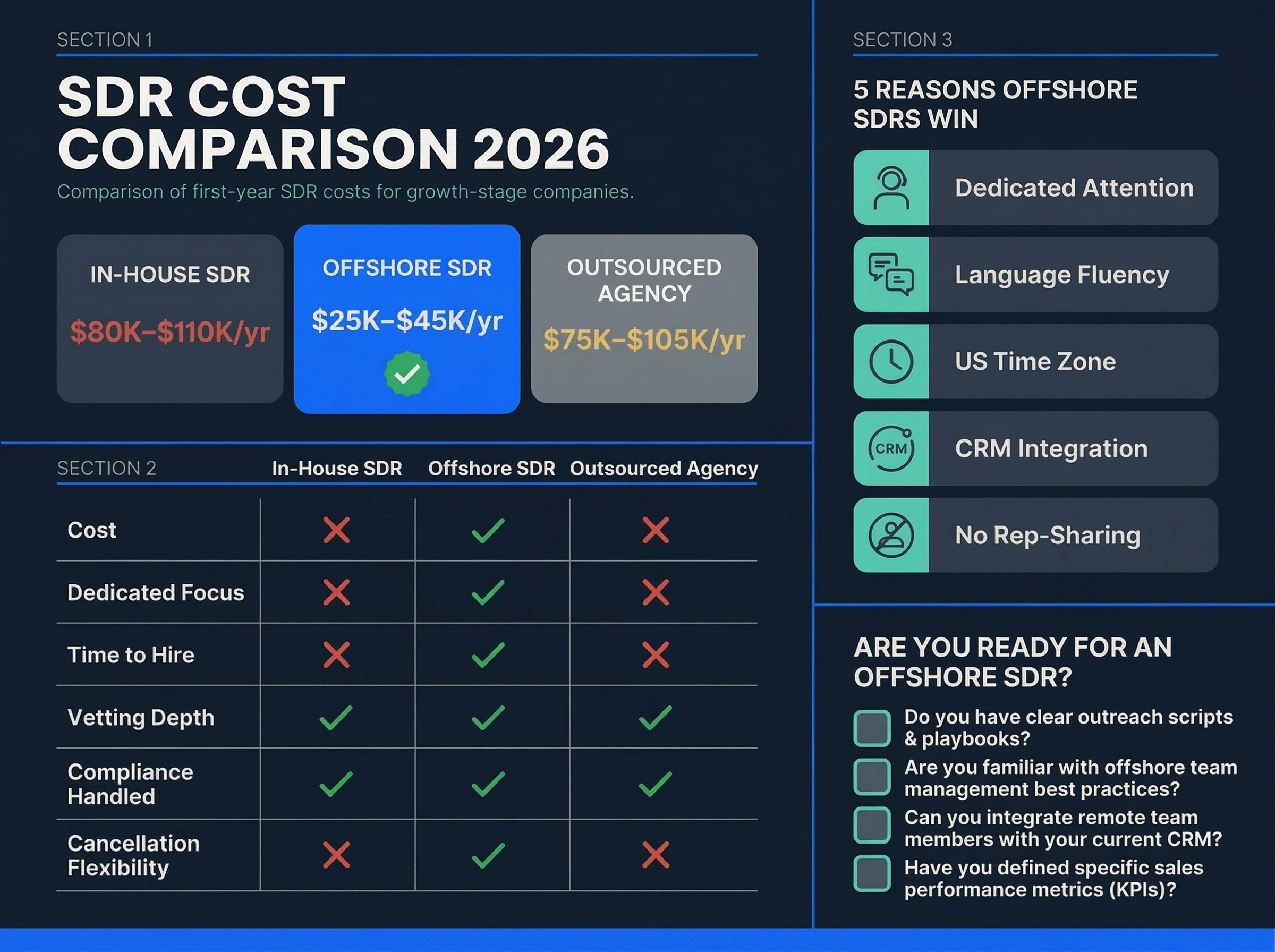
An offshore SDR costs $25,000–$45,000 per year all-in when placed through a managed firm like Remote Growth Partners. This includes the rep's compensation, compliance management, and account support. The equivalent domestic in-house SDR costs $80,000–$110,000+ annually when benefits, payroll taxes, recruiting fees, and ramp-time productivity loss are factored in. The offshore model saves most companies $40,000–$70,000 per year per SDR headcount.
Most offshore SDRs reach full productivity within 30–45 days with structured onboarding. The first two weeks typically cover ICP training, sales playbook review, and CRM setup. Weeks three and four involve supervised outreach with active feedback. By week five, most reps are running independent sequences and booking meetings. RGP's 30-day offshore SDR onboarding playbook walks through each phase in detail.
Yes. Offshore SDRs in countries like the Philippines, Colombia, and South Africa routinely work US business hours and make live cold calls to US prospects. Filipino SDRs in particular have decades of professional experience in US-aligned customer-facing roles and are well-suited for cold calling. Colombian reps work in overlapping or identical time zones to US Eastern and Central time. The calls work, what matters is communication quality, which RGP's vetting process screens for explicitly.
Effective offshore SDRs use the same tools as domestic reps: a CRM (Salesforce or HubSpot), a sales engagement platform (Outreach, Salesloft, or Apollo), a prospecting database (Apollo, ZoomInfo, or LinkedIn Sales Navigator), and a calling solution (Aircall, RingCentral, or similar). RGP screens candidates for prior hands-on experience with these platforms during the vetting process. Clients provide tool access; RGP ensures candidates can hit the ground running.
An SDR (Sales Development Representative) focuses primarily on outbound prospecting: cold outreach, meeting-setting, and pipeline generation from new accounts. A BDR (Business Development Representative) often covers a broader scope that may include inbound lead qualification, partnership development, or outbound to larger strategic accounts. In practice, the distinction varies by company. Offshore reps can fill either seat, and many RGP clients hire offshore BDRs as well. The key differentiator in both cases is the dedicated, full-time model versus shared agency alternatives.
Track the same metrics you'd use for a domestic SDR: outreach volume (emails and calls per day), response rate, meeting-accepted rate, and pipeline generated per month. Set benchmarks during onboarding: typical targets for a ramped SDR are 40–80 outreach touches per day and 8–15 qualified meetings booked per month, though this varies by market and deal size. RGP recommends building a simple weekly scorecard and reviewing it in a standing 30-minute check-in with your offshore rep. Clear metrics remove ambiguity and keep both sides accountable. If you're not sure what benchmarks apply to your market, read real client reviews from RGP clients to see what production looks like in similar contexts.
Recruiting, testing, and interviewing the most talented SDRs, designers, video editors, and marketers from overseas.