Share this post


.svg)

Your business needs consistent, high-quality design work. The question is whether you pay a local agency $4,000–$8,000 per month for that output — or whether a vetted offshore graphic designer can deliver the same results at 60–75% less. For most growth-stage companies and SMBs in 2026, the answer isn't just about saving money. It's about finding the right fit for your workflow, your brand, and your long-term scale.
Quick Answer: An offshore graphic designer is typically 60–80% cheaper than a local agency retainer, offers dedicated brand focus, and can match or exceed agency output quality when properly vetted. A local agency is better suited for one-time, high-complexity campaign launches or businesses that lack the bandwidth to onboard and manage a remote hire. For recurring design needs — social media content, pitch decks, email graphics, ad creatives — an offshore designer almost always delivers better ROI.
Key Takeaways:
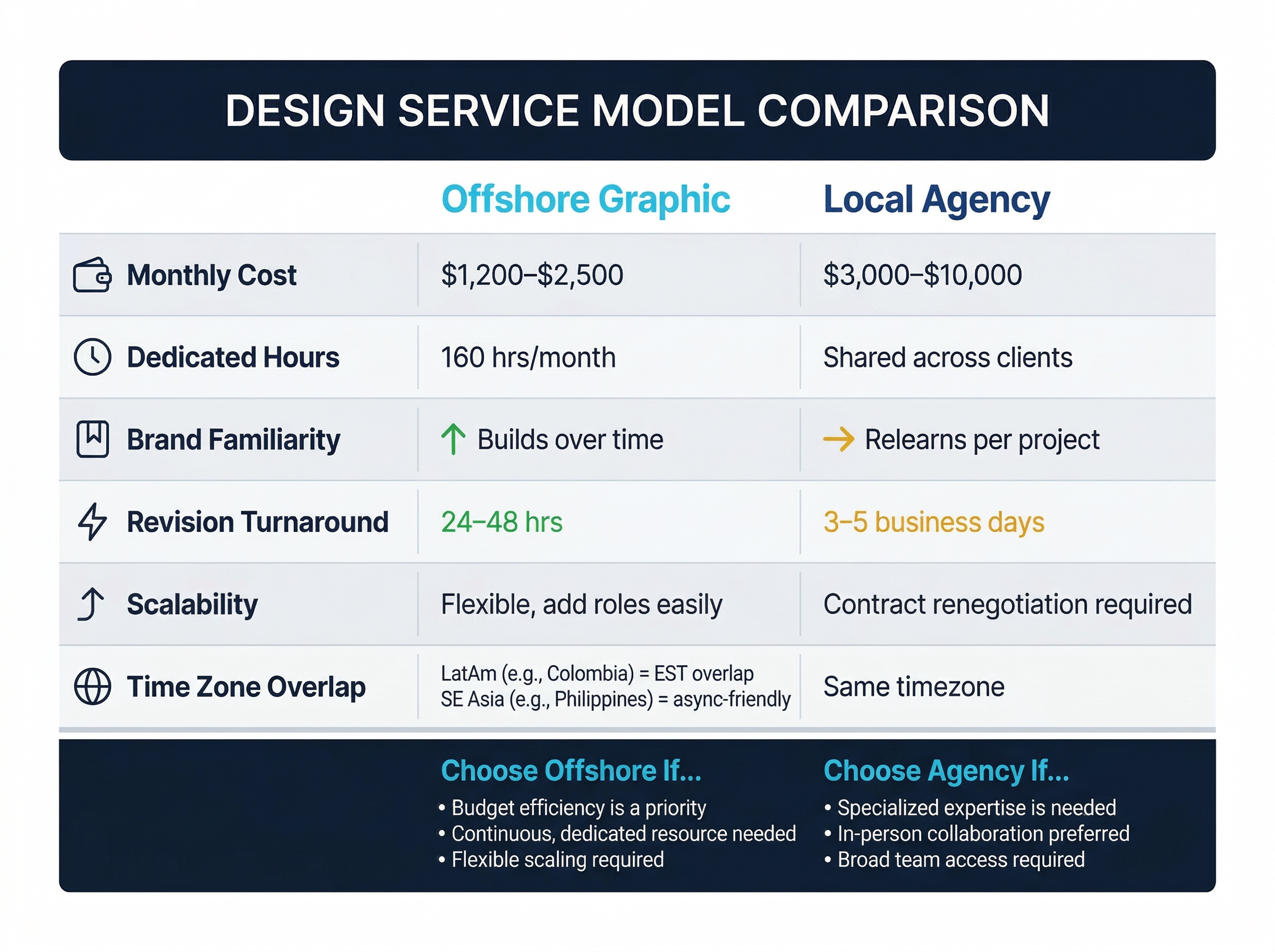
- Offshore graphic designers cost $800–$2,000/month compared to $3,000–$10,000/month for a local agency retainer
- Quality is not a trade-off — vetted offshore designers from countries like the Philippines, Colombia, and South Africa consistently produce agency-level work
- Dedicated offshore designers learn your brand deeply over time; agencies frequently rotate staff
- Time zone challenges are manageable with the right tools and hire location (Colombia offers near-perfect EST overlap)
- A hybrid model — offshore designer for daily production, local agency for major campaign launches — is the optimal setup for many growing businesses
When most business owners say "offshore graphic designer," they picture a random Fiverr freelancer with inconsistent quality and no accountability. That's not what this article is about.
A vetted offshore graphic designer, as placed through a firm like Remote Growth Partners, is a dedicated, full-time or part-time remote professional hired from talent-rich markets such as the Philippines, Colombia, South Africa, or Pakistan. They work your hours, follow your brand guidelines, use the same tools your team uses (Adobe Creative Suite, Figma, Canva Pro), and are your designer — not shared across ten other clients.
A local design agency, by contrast, is a service provider. You purchase a block of hours or deliverables each month. Your account manager coordinates internally, briefs their team, and delivers outputs. You rarely interact directly with the person doing the work, and that person may change month to month.
These are fundamentally different operating models — and the right choice depends on your design volume, budget, internal capacity, and growth stage.
Cost is the most visible difference, but it's worth understanding why the gap exists — and whether what you're giving up justifies the savings.
Local design agency retainers in 2026 typically range from $3,000 to $10,000 per month, depending on deliverable volume, agency size, and market. A mid-tier agency retainer averaging $5,000/month adds up to $60,000 per year — and that's before project overages, rush fees, or scope renegotiations.
According to the Bureau of Labor Statistics ↗, the median annual wage for graphic designers in the United States is approximately $58,000 — and agencies mark that up significantly to cover overhead, profit margin, and account management.
A full-time, vetted offshore graphic designer placed through Remote Growth Partners typically costs between $800 and $2,000 per month (including placement and support fees), depending on experience level and country of hire. That's $9,600 to $24,000 per year — a saving of $36,000 to $50,000+ annually compared to a mid-range agency retainer.
| Factor | Offshore Graphic Designer | Local Design Agency |
|---|---|---|
| Monthly Cost | $800 – $2,000 | $3,000 – $10,000 |
| Annual Cost | $9,600 – $24,000 | $36,000 – $120,000 |
| Dedicated Hours/Month | 160 hrs (full-time) | 20–40 hrs typical retainer |
| Revision Turnaround | Same-day to 24 hrs | 2–5 business days |
| Brand Familiarity | Deep (grows over time) | Low-medium (staff rotation) |
| Account Manager Access | Direct communication | Via account manager |
| Staff Continuity | High (dedicated hire) | Low-medium (rotated teams) |
| Scalability | Add headcount on demand | Renegotiate contract |
| IP Ownership Clarity | Work-for-hire by default | Varies by contract |
This is the objection that stops most business owners from pulling the trigger — and it's worth addressing directly. Yes, offshore designers can match and often exceed the output quality of a local agency, provided they are rigorously vetted.
At Remote Growth Partners, the vetting process for offshore graphic designers includes multiple screening layers before a candidate is ever presented to a client:
You can learn more about how Remote Growth Partners vets offshore talent before any candidate reaches your inbox.
Local agencies genuinely excel in specific scenarios: integrated campaigns that require strategy, copywriting, and design to move in lockstep; brand identity projects from scratch; or highly regulated industries where in-person collaboration is essential.
Where agencies consistently fall short is in day-to-day content production. A retainer that costs $5,000/month rarely includes unlimited revisions, same-day turnaround, or a designer who knows your brand as intimately as an internal hire. The person who designed your Q1 campaign may not be the one producing your Q2 social graphics. That inconsistency compounds over time.
The hidden cost of agency work isn't in the retainer — it's in the briefing overhead, revision cycles, and brand drift that occur when no single designer owns your visual identity long-term.
For high-volume, recurring design needs, a dedicated offshore designer is almost always faster than an agency.
Consider a common scenario: you need five social media graphics, a one-page sales sheet, and two email banner variants by end of week. A local agency, juggling 10–15 active clients, typically turns these around in 3–5 business days — assuming no revision cycles push the timeline.
A dedicated offshore designer working your hours (or with significant overlap) can deliver the same output in 24–48 hours, with revisions addressed same-day. Because they aren't shared across multiple clients, your project is always the priority.
The Nielsen Norman Group ↗ has documented how design iteration speed directly correlates with output quality — faster feedback loops produce better-refined work. A dedicated offshore designer enables exactly this kind of tight feedback cycle.
The most common concern with offshore hiring isn't quality — it's communication. Here's how the reality breaks down.
Time zone management is a solvable problem, and the solution depends heavily on where your designer is based:
The tools that make offshore design collaboration work in 2026:
See our guide to best countries to hire offshore marketing talent in 2026 for a deeper breakdown by region.
With a local agency, you're not managing the designer — you're managing a relationship with an account manager who manages the designer. This layer adds bureaucratic overhead. Every brief goes through interpretation. Every revision request gets filtered. You lose directness, and directness is what drives speed and accuracy in creative work.
Here's a scenario that plays out repeatedly among growing companies: you start with one designer's worth of work, hit a growth inflection, and suddenly need twice the design capacity. With a local agency, that conversation means renegotiating your contract, likely at a higher tier, with a significant cost jump.
With an offshore model, scaling means adding a second dedicated designer — or shifting an existing hire from part-time to full-time. The cost curve stays predictable and linear.
A full-time offshore design hire also develops something agencies can't replicate: institutional brand knowledge. After three to six months, a dedicated offshore designer knows your brand standards, your preferred revision language, your audience sensibilities, and your approval process. That compounding familiarity makes every subsequent deliverable faster and more accurate.
For a comprehensive look at building out your offshore marketing function, see our offshore marketing talent growth plan for 2026.
IP protection is a legitimate concern when hiring any remote creative professional — offshore or domestic. The key is structuring the engagement correctly from the start.
When you hire through Remote Growth Partners, every engagement includes:
According to guidance from the World Intellectual Property Organization (WIPO) ↗, clear contractual IP assignment is the most effective protection mechanism for cross-border creative work — more so than geography. In other words, a poorly structured domestic contract offers less protection than a well-structured offshore one.
Many of the most sophisticated marketing operations in 2026 don't choose between offshore designers and local agencies — they use both strategically.
The model looks like this: a dedicated offshore designer handles all day-to-day production — social media graphics, internal presentations, email templates, ad creative variants, blog imagery. A local agency is engaged for high-stakes launches — annual brand refreshes, major campaign creative direction, or event materials requiring physical production management.
This hybrid model captures the cost efficiency of offshore hiring for high-volume work while retaining agency-level strategic support for the moments that genuinely benefit from it. It also insulates your brand from the risk of agency-only dependence — if your agency relationship ends, your design operations don't grind to a halt.
According to a Deloitte Global Outsourcing Survey ↗, 70% of companies cite cost reduction as the primary driver for outsourcing — but 40% equally cite the need for access to specialized skills. A hybrid design model addresses both motivations simultaneously.
Remote Growth Partners specializes in sourcing, screening, and placing offshore creative talent — including graphic designers — for US-based SMBs and growth-stage companies. The process is built to eliminate the risk and guesswork that typically make offshore hiring feel daunting.
Here's how the process works:
You can browse the full range of offshore roles we place, or go directly to the hire a vetted offshore graphic designer page to see what's available right now.
Want to hear from businesses that have already made the switch? See what our clients say about working with offshore design hires placed through RGP.
The offshore graphic designer vs. local agency decision comes down to volume, budget, and operational model — not quality. Offshore graphic designers placed through vetted staffing firms consistently deliver agency-level work at 60–80% lower cost, with the added advantage of brand familiarity and dedicated capacity that local agencies structurally cannot offer. Countries like Colombia, the Philippines, and South Africa provide talent pools with strong English proficiency, relevant technical skills, and flexible time zone availability for US-based businesses. IP protection and confidentiality are fully manageable through work-for-hire contracts and NDAs when structured correctly. For businesses with ongoing design needs, hiring a dedicated offshore graphic designer almost always generates better ROI than a local agency retainer — and the hybrid model remains the optimal choice for companies that need both day-to-day production capacity and strategic campaign support.
For most businesses with recurring design needs, yes — emphatically. An offshore graphic designer costs 60–80% less than a local agency retainer and, when properly vetted, delivers comparable or superior output quality due to dedicated focus on your brand. The ROI compounds over time as the designer builds institutional knowledge of your brand standards and preferences. The main investment is in the initial onboarding and workflow setup, which typically pays for itself within the first month.
Local design agency retainers in 2026 typically range from $3,000 to $10,000 per month, totaling $36,000 to $120,000 annually. A full-time vetted offshore graphic designer costs approximately $800 to $2,000 per month — $9,600 to $24,000 per year. The offshore option delivers significantly more dedicated hours (160/month full-time vs. 20–40 hours in a typical agency retainer) at a fraction of the price.
The primary risks are communication friction, inconsistent quality from unvetted hires, and IP exposure — all of which are mitigated through proper vetting, contractual structure, and tool selection. Hiring through a specialist firm like Remote Growth Partners eliminates the quality and vetting risk. NDAs and work-for-hire agreements address IP concerns. Time zone differences are resolved through async briefing workflows and strategic hire location (Colombia, for example, shares EST hours almost entirely).
Yes — depending on where they're based. Colombian designers work in EST, making real-time collaboration seamless for US businesses. South African designers offer a 6-hour overlap with US mornings. Filipino designers are 12–13 hours ahead of EST but frequently work flexible hours to accommodate US business hours, and async tools like Loom and Figma bridge any remaining gap. Time zone is a solvable logistics question, not a fundamental barrier.
IP protection relies on contractual structure, not geography. Every engagement through Remote Growth Partners includes a work-for-hire clause (assigning all creative output to you), a signed NDA, and clearly scoped access controls for your brand assets and platforms. According to WIPO, proper contractual IP assignment is the most effective cross-border protection mechanism available — more reliable than domestic-only hiring without a formal agreement in place.
A freelance graphic designer (as found on platforms like Fiverr or Upwork) is a self-directed contractor who works across multiple clients simultaneously, with no dedicated commitment to your brand and highly variable quality and reliability. An offshore graphic designer, as placed through a vetting firm, is a dedicated hire — full-time or part-time — who works exclusively or primarily for your business, undergoes rigorous skills screening, and operates within a formal contractual framework. The difference in quality, consistency, and accountability is significant.
Recruiting, testing, and interviewing the most talented SDRs, designers, video editors, and marketers from overseas.