Share this post


.svg)

Plenty of US businesses have tried this once, watched their ad spend drain into poorly structured campaigns, and swore they'd never go offshore again. The problem wasn't hiring offshore. The problem was hiring without a real vetting process.
Done right, hiring an offshore paid ads specialist in 2026 can cut your paid media labor costs by 50–70% while keeping campaign performance at the same level you'd expect from a US-based hire. Done wrong, you're looking at wasted budget, platform policy violations, and zero accountability when things go sideways.
This guide covers exactly how to get it right.
Quick Answer: To hire an offshore paid ads specialist without getting burned, require proof of real ad spend managed (not just certifications), administer a paid real-work test before extending any offer, and make sure your staffing partner handles compliance and payroll classification. Platforms like RGP run a 4-stage vetting process specifically designed to filter out candidates who can pass a theory test but can't execute under live campaign conditions.
Key Takeaways:
- US-based senior PPC specialists cost $70,000–$100,000+ per year in salary alone; offshore equivalents with comparable skills typically cost 50–70% less in 2026.
- The most common ways businesses get burned: no real-work test, hiring generalists for specialist roles, and ignoring contractor misclassification risk.
- Google Ads certification, Meta Blueprint, and verifiable experience managing real monthly ad budgets (not just $500 test campaigns) are non-negotiable requirements.
- RGP's 4-stage vetting process includes a paid real-work test specific to paid ads roles, which is the main differentiator from freelance marketplaces.
- Proper onboarding, KPI frameworks, and platform access controls matter as much as who you hire.
The math is hard to ignore. A full-time, experienced PPC manager in a US metro market commands a base salary of $75,000–$100,000 before you factor in benefits, payroll taxes, and recruiting fees. Many agencies are paying even more for specialists with strong Meta and Google performance records.
The offshore alternative is not a compromise, assuming you know how to hire. Strong paid media talent exists in markets like the Philippines, Colombia, South Africa, and Egypt, where the same skill set costs significantly less, not because the quality is lower, but because the cost of living is different. You can read more about the best countries for offshore marketing talent in 2026 if you want a breakdown by region.
Here's what the numbers actually look like:
| Role | US Annual Salary (2026) | Offshore Annual Cost (via RGP) | Estimated Savings |
|---|---|---|---|
| Junior PPC Specialist | $50,000–$65,000 | $18,000–$28,000 | ~55–65% |
| Mid-Level Paid Ads Manager | $65,000–$85,000 | $24,000–$38,000 | ~55–65% |
| Senior PPC Strategist | $85,000–$110,000 | $32,000–$50,000 | ~50–60% |
| Paid Social Specialist (Meta/TikTok) | $60,000–$80,000 | $22,000–$35,000 | ~55–65% |
These figures reflect full-time, dedicated hires. Not shared resources. Not per-project contractors. A specialist who works exclusively for your business, managed on the payroll and compliance side by RGP.
The savings are real. But here's what matters more: you are not trading quality for cost when you hire through a rigorous vetting process. What you are trading is US overhead costs. The underlying analytical skills, platform knowledge, and campaign execution ability are independent of geography.
That said, the offshore talent market is not uniform. There's a wide gap between someone who passed a Google Ads certification course last month and someone who has actively managed $50,000+ monthly budgets, run multivariate ad tests, and navigated account suspensions. Your vetting process has to be sharp enough to tell them apart.
Most bad hires follow a predictable pattern. These are the five errors that show up repeatedly.
Google Ads and Meta Ads are different ecosystems with different bidding logic, audience structures, and optimization levers. A candidate who is strong on Meta but weak on Google Search will cause real damage if you hand them a Google Shopping campaign without realizing the gap.
Always verify platform-specific experience separately. Ask for screenshots of active campaign dashboards, not just certification badges. Certifications confirm someone studied the documentation. They don't confirm the person can manage a $20,000/month budget under real performance pressure.
A social media manager who "also does ads" is not a paid ads specialist. These are distinct disciplines. Paid media requires fluency in conversion tracking, audience segmentation, bidding strategy, landing page alignment, and attribution modeling. A generalist digital marketer typically lacks depth in at least half of those areas.
Be specific in your job requirements. If you run e-commerce, you need someone with Shopping and Performance Max experience. If you're B2B, LinkedIn Campaign Manager and Google Search are the priority. The more specific your requirements, the better your filter.
This is the single biggest differentiator between a good hire and a costly mistake.
A real-work test doesn't mean a quiz. It means giving the candidate a realistic scenario: a set of campaign performance data, a budget constraint, and a business objective, then asking them to diagnose what's wrong and recommend a specific course of action with justification. The test should take 60–90 minutes and be compensated.
"Most offshore hiring failures trace back to one decision: skipping the practical test because the candidate's resume looked strong enough. Resumes can be polished. Live campaign thinking can't be faked."
Upwork and Fiverr are fine for low-stakes, short-term tasks. They are not the right tool for hiring someone to manage your Google Ads account full-time. The review systems on these platforms don't tell you whether someone can actually manage a $30,000/month ad budget. They tell you whether previous clients were satisfied, which is a much lower bar.
The deeper problem: there is no standardized vetting on these platforms. Anyone can create a profile, display a certification badge, and bid on your job. Without a structured skills assessment layer sitting between you and the talent pool, you're essentially hiring blind.
This one costs businesses money in a different way: legal exposure.
Classifying a full-time offshore paid ads manager as an independent contractor, when they work exclusively for you on a set schedule, can trigger misclassification liability under IRS guidelines ↗ and local labor law in the worker's country. The penalties vary by jurisdiction but can include back taxes, benefits owed, and fines.
RGP handles payroll and compliance for every placed hire, so you don't carry that risk. It is one of the reasons working with a structured staffing partner is different from going direct or through a freelance marketplace.
Minimum certifications to require in 2026:
Certifications are a starting point, not a finish line. Pair every certification check with a request for verifiable campaign history. According to Google's own Skillshop program ↗, certifications must be renewed annually, so an expired badge is a red flag about how actively a candidate is working in the platform.
There is a real difference between someone who has managed campaigns with a $500 monthly budget and someone who has managed $30,000+ per month. At higher spend levels, the optimization decisions become more consequential. Bidding strategy errors, poor audience exclusions, or misaligned attribution windows cost real money, fast.
Ask for specific examples: what was the monthly budget, what was the starting ROAS or CPA, and what did they change to improve it? A strong candidate answers this with specifics. A weak candidate gives vague answers about "improving performance."
Paid media is as much analytics as it is advertising. Your hire needs to be comfortable in Google Analytics 4, Meta Ads Manager reporting, and ideally a third-party attribution tool like Triple Whale or Northbeam. They should be able to explain the difference between last-click and data-driven attribution and tell you which one your business should be using and why.
According to the Interactive Advertising Bureau's 2025 Internet Advertising Revenue Report ↗, US digital ad spend exceeded $300 billion in 2024, with paid search and paid social accounting for the majority. The volume of spend in these channels makes analytically capable paid media managers one of the highest-use hires a business can make.
Offshore doesn't have to mean asynchronous. Many candidates in markets like Latin America and Eastern Europe have full timezone overlap with US business hours. Even candidates in the Philippines can work US hours with a reasonable schedule adjustment.
Set clear expectations before the hire is finalized: weekly check-in call, response time expectations, and reporting deadlines. Timezone logistics are solvable. What is not solvable after the fact is a communication style mismatch with your team's rhythm.
Here's a direct answer to the most common question we hear: How do I hire an offshore paid ads specialist without getting burned?
That process is exactly what RGP runs on every candidate. Here's how it breaks down stage by stage. You can also read more about how RGP's vetting process works on the full methodology page.
Every applicant's work history is manually verified. Past employers are contacted. Campaign history claims are cross-checked. A candidate who says they managed $50,000/month in ad spend needs to be able to demonstrate that, not just assert it.
This stage also filters for red flags: gaps in paid media history, certifications that expired years ago, or job descriptions that suggest "managed ads" meant posting boosts rather than running structured campaign builds.
Shortlisted candidates take a platform-specific knowledge assessment. This is not a generic digital marketing quiz. It covers bid strategy mechanics, audience targeting logic, conversion tracking setup, and campaign structure for the specific platforms relevant to the role (Google Search, Meta, LinkedIn, or a combination).
Candidates who pass the knowledge test proceed. Those who demonstrate surface-level knowledge but can't explain the reasoning behind campaign decisions are filtered out here.
This is the step that separates RGP's process from what you'll find on a freelance marketplace. Candidates receive a realistic campaign scenario with real data: a set of ad group performance metrics, a budget, and a business objective. They have to diagnose what's underperforming, explain why, and build out a specific recommendation.
RGP's paid real-work test filters out candidates who cannot execute under real campaign conditions. A candidate can memorize Google's documentation and still fail this test if they lack the analytical judgment to apply it. This stage eliminates the majority of otherwise credentialed candidates who don't make the cut.
The final stage is a structured interview focused on communication clarity, problem-solving approach, and fit with the client's industry context. A paid ads manager for an e-commerce brand needs a different orientation than one working for a B2B SaaS company. This stage is where that alignment gets confirmed.
A realistic budget for an offshore paid ads specialist placed through RGP in 2026:
| Experience Level | Monthly Cost (Offshore via RGP) | Equivalent US Salary | Savings vs. US |
|---|---|---|---|
| 1–3 years experience | $1,500–$2,400/month | $50,000–$65,000/year | ~55–65% |
| 3–5 years experience | $2,000–$3,200/month | $65,000–$85,000/year | ~55–65% |
| 5+ years / Senior | $2,800–$4,200/month | $85,000–$110,000/year | ~50–60% |
These costs include RGP's payroll and compliance management. There are no hidden payroll taxes for you to manage, no contractor misclassification risk, and no additional HR overhead.
Compare this to going direct through Upwork, where you may find lower headline rates but carry the full burden of vetting quality, managing compliance, and handling platform access security on your own. The cost difference between "cheap" and "managed" becomes very clear after one bad hire.
Businesses that invest in properly vetted offshore paid media talent and set up structured onboarding consistently report positive ROI within 60–90 days. The savings compound every month a strong hire stays on your team.
You can explore the full range of offshore marketing talent roles we place to see where paid ads fits alongside other growth-critical positions.
The hire is only part of the equation. Onboarding determines whether that person becomes productive in 30 days or 90.
Before your new hire touches an ad account, define the metrics that matter. At minimum:
Set a formal 30-day review. Give honest feedback early rather than waiting for 90-day problems to surface. A strong hire will want the KPI clarity. It is the weak hires who avoid it.
Never share master login credentials for your Google Ads or Meta Business Manager accounts. Every platform supports user-level access controls:
Document what access was granted and when. Review access quarterly. If a hire leaves, revoke access on the same day. These are basic controls, but they're often skipped in the rush to onboard.
For more on building and managing an offshore marketing team, see our offshore marketing talent growth plan for 2026.
Hiring an offshore paid ads specialist in 2026 can reduce paid media labor costs by 50–70% compared to US-based equivalents, without sacrificing campaign quality, provided the vetting process is rigorous. The most costly mistakes when trying to hire an offshore paid ads specialist are skipping real-work tests, hiring generalists for specialist roles, and misclassifying workers as contractors when they function as full-time employees. RGP's 4-stage vetting process, which includes a paid real-work test specific to paid ads roles, is designed to surface candidates with verifiable platform experience and real budget management history. Platform certifications from Google and Meta, combined with documented ad spend history and analytical capability, are the baseline requirements for any offshore paid media hire. Proper onboarding, including defined KPIs, secure platform access management, and a structured reporting cadence, is what determines whether the hire delivers ROI within 30–60 days.
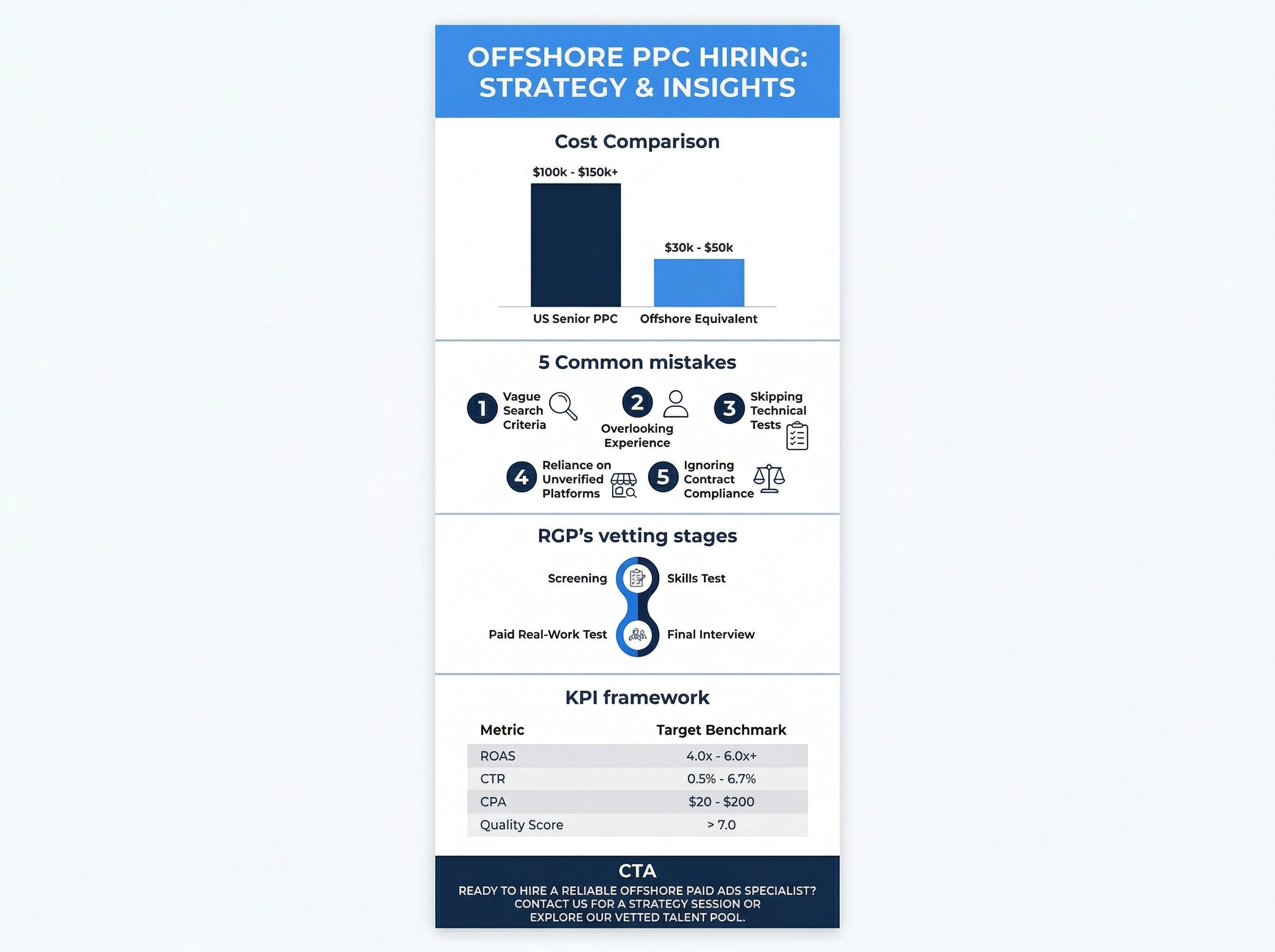
An offshore paid ads specialist placed through a managed staffing partner like RGP typically costs $1,500–$4,200 per month in 2026, depending on experience level and platform specialization. This compares to $50,000–$110,000 per year for a US-based equivalent, representing 50–65% in savings. The monthly cost includes payroll and compliance management.
Yes, with the right controls in place. Use platform-level user access (not shared credentials), document all permissions, and work with a staffing partner that runs a structured vetting process. The risk isn't geography. The risk is hiring someone unqualified regardless of where they're based.
At minimum: Google Ads Certification (Search and ideally Shopping or Performance Max), Meta Blueprint Certification, and verifiable hands-on experience managing real monthly budgets. LinkedIn Campaign Manager experience is important for B2B advertisers. Check that certifications are current. Google's certifications expire annually ↗, so an outdated badge indicates the candidate hasn't been actively working in the platform.
Ask for campaign performance data with specific before/after metrics. Administer a paid real-work test using realistic campaign scenarios, not a theory quiz. Check that ad spend claims are backed by screenshots or employer verification. Certifications alone don't confirm execution ability.
A staffing agency like RGP runs a multi-stage vetting process, handles payroll and compliance, and provides a dedicated account manager. Upwork gives you access to a large talent pool with no standardized vetting, no compliance coverage, and no accountability layer between you and the contractor. The headline cost on Upwork may look lower, but it doesn't include the risk of a bad hire, legal misclassification exposure, or the time you spend vetting on your own.
Yes. Candidates in Latin America (Colombia, Mexico, Argentina) have natural timezone overlap with US East and Central time. Eastern European candidates often cover US morning hours. Even candidates in the Philippines can work US hours with a schedule adjustment. Confirm timezone expectations explicitly before the hire is finalized.
Recruiting, testing, and interviewing the most talented SDRs, designers, video editors, and marketers from overseas.