Share this post


.svg)
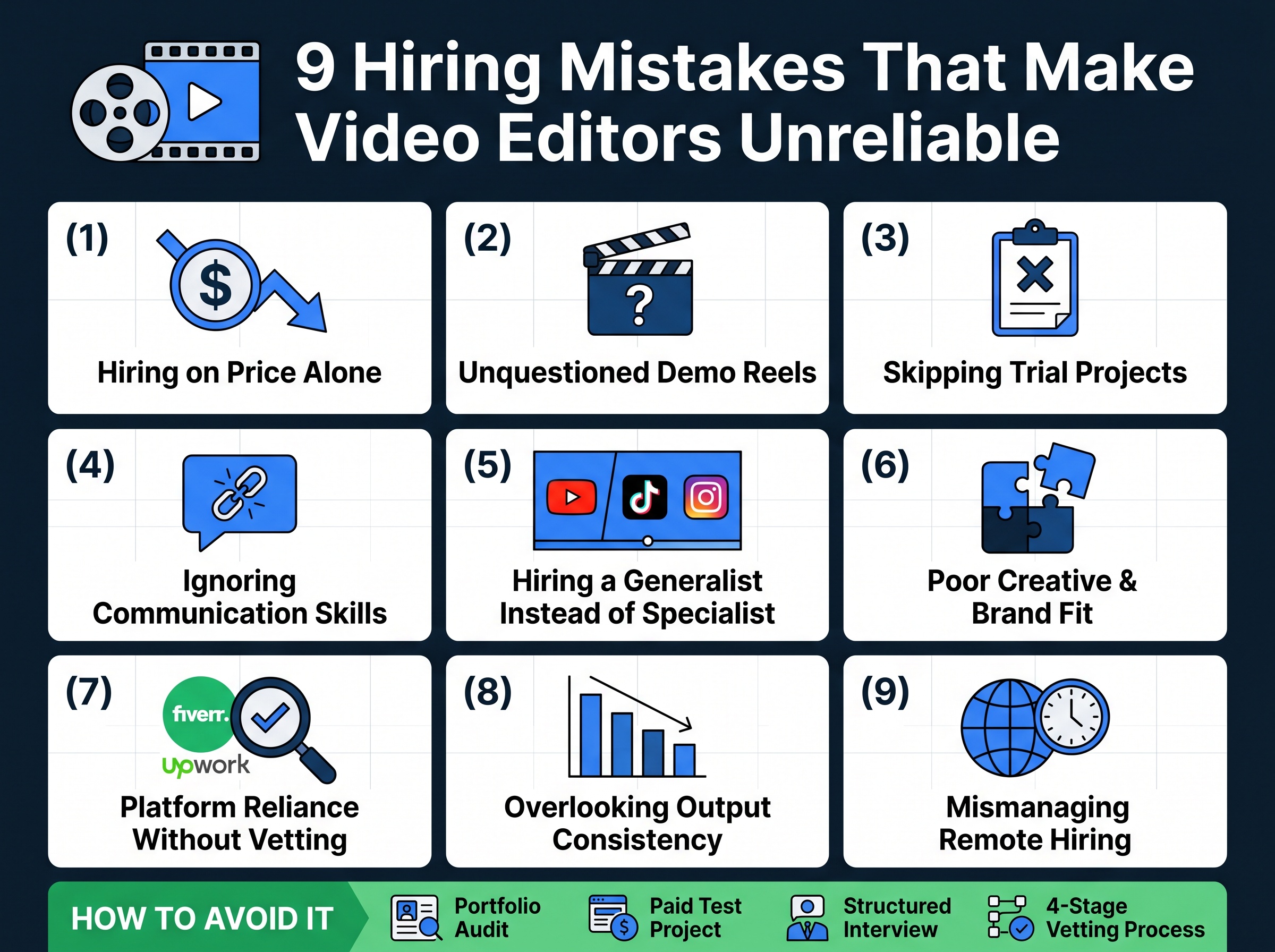
The most common hiring mistakes that lead to unreliable video editors include prioritizing cost over creative fit, skipping structured trial projects, and misjudging communication skills during the interview. These errors compound quickly: a misaligned editor wastes revision cycles, misses deadlines, and produces inconsistent output that erodes brand trust over time.
Quick Answer: Unreliable video editors are almost always the result of a flawed hiring process, not just bad luck. The most common culprits are price-first hiring, skipping paid test projects, and failing to distinguish between generalist editors and platform specialists. Fix the process, and the results follow.
Key Takeaways:
- Hiring based on rate alone is the single fastest path to inconsistent, off-brand video output.
- A demo reel shows an editor's ceiling, not their floor. Always ask contextual questions about the work you see.
- A paid real-work trial project is the single most reliable predictor of on-the-job performance.
- Communication skills predict long-term reliability more accurately than a polished portfolio.
- YouTube, TikTok, and Instagram Reels require genuinely different editing instincts, a generalist won't cut it for any of them.
Most businesses that struggle with unreliable video editors made their biggest mistake before the editor ever opened a timeline. The hiring process itself was broken.
They posted a generic job description, sorted applicants by rate or reviews, watched a few portfolio clips, and sent an offer. That's not a vetting process, it's a shortcut that guarantees the problems you're trying to avoid.
The good news: every mistake on this list is preventable. Each one has a concrete fix. Work through them, and you'll hire editors who show up consistently, communicate clearly, and actually understand what your brand is trying to say.
Price-first hiring is the single most common reason video editors underperform. When cost is the primary filter, you're selecting for editors who've learned to compete on rate, not on results.
Low-rate editors often have significant gaps in three specific areas: brand storytelling ability, pacing instinct, and consistency of output across a volume of work. They may produce one solid video, but the fifth, tenth, or twentieth will start to drift in quality as novelty wears off and deeper skill gaps surface.
According to LinkedIn's 2026 Workforce Confidence Report ↗, the cost of a bad creative hire, when accounting for wasted production time, revisions, and rehiring, regularly exceeds 1.5x the original annual contract value.
The ROI of video content depends almost entirely on whether that content connects with the target audience. A cheap edit that misses the pacing and emotional arc of a well-produced piece doesn't just underperform, it actively works against the brand. Use the video editing cost savings calculator at Remote Growth Partners to model what you actually save (and risk) at different rate tiers.
A demo reel tells you what an editor is capable of on their best day, with their best client, on a project that gave them full creative latitude. It tells you almost nothing about how they'll perform on your content, under your brief, at your pace.
Every editor curates their reel to impress. That's expected. The problem is taking it at face value.
Ask these three questions about any portfolio piece you're considering:
If a candidate gets defensive or vague answering these questions, that's a signal. Confident editors can walk you through their decision-making process because they were genuinely in control of it.
Vague portfolio explanations are one of the clearest offshore video editor red flags in the industry. An editor who can't explain why they made a cut, chose a music track, or structured a sequence a certain way probably didn't make those choices intentionally.
No amount of portfolio review replaces watching someone work with your actual footage, your actual brand guidelines, and your actual feedback.
A paid trial project is non-negotiable. "Paid" matters, asking candidates to work for free filters out the best ones, who have other options and won't bother. A small paid test signals that you're serious and that you respect the craft.
The test should use real content. Give the editor raw footage from an actual project (or a close analogue), a real brief, and a realistic deadline. Then evaluate three things: the output quality, how they handled the brief, and how they communicated during the process.
Remote Growth Partners uses a paid real-work test as a core component of the 4-stage vetting process RGP uses for offshore video editors. Candidates who pass it have already proven they can perform under the actual conditions your team creates, not just the ideal conditions they constructed for their portfolio.
A technically skilled editor who communicates poorly is a productivity liability. They'll misinterpret briefs, avoid flagging problems until it's too late, and burn your revision cycles on preventable misunderstandings.
The interview isn't just about reviewing past work. Use it to observe how they think and talk in real time.
Try these questions:
Listen for editors who ask clarifying questions back at you during the interview itself. That instinct, the habit of seeking clarity before diving in, is exactly what you need in day-to-day work. The 8 interview questions to spot great offshore editors from Remote Growth Partners covers this in more depth with scoring rubrics you can use.
"I can edit anything" is a claim that sounds reassuring until you get a YouTube long-form editor's instincts applied to a 15-second TikTok hook. Platform-specific video editing is a distinct skill set.
| Platform | Core Editing Skills Needed | What Generalists Miss |
|---|---|---|
| YouTube | Retention curve management, chapter structure, thumbnail-to-content alignment, 8–12 min pacing | Pacing for mid-video drop-off, end screen optimization |
| TikTok | Hook engineering in the first 2 seconds, caption timing, trending audio instincts, vertical framing | Platform-native pacing, native feel vs. "produced" look |
| Instagram Reels | B-roll rhythm, music sync, visual storytelling in 30–90 seconds | Cross-platform repurposing nuance, Reels vs. Feed distinction |
| LinkedIn Video | Professional tone, subtitles-first editing, thought leadership pacing | Over-production, wrong energy for the platform |
If your business is publishing across multiple platforms, you either need a specialist per format or an editor who has demonstrably done each format professionally, not just once or twice.
Technical proficiency is the floor, not the ceiling. An editor who knows Adobe Premiere Pro inside out but doesn't understand your audience, your tone, or your narrative arc will produce content that is technically correct and emotionally flat.
Send candidates a short "brand immersion packet" before the interview: three videos that represent the tone you're going for, a one-paragraph description of your audience, and two examples of content that missed the mark. Ask them to react to it.
Strong candidates will immediately identify what the good examples do right at a narrative level. They'll talk about emotional pacing, not just cut timing. They'll reference the audience, not just the footage.
Weak candidates will focus on the technical elements: "Good color grade, clean transitions." That's not wrong, it's just incomplete. An editor who leads with craft but follows with nothing about feeling isn't ready to represent a brand independently.
Fiverr, Upwork, and Bark lower the barrier to entry for hiring video editors. That's also their primary limitation.
Freelance platforms create volume and convenience, but they strip out accountability. There are no structured vetting processes, no paid test projects built into the hiring flow, no ongoing management once the gig is complete, and no continuity between projects.
The editors who win on platforms like these often do so through review manipulation, cherry-picked portfolios, and aggressive underbidding. Research from Stanford's Graduate School of Business ↗ on platform labor markets suggests that review scores on freelance platforms correlate more strongly with response time and politeness than with output quality.
And there's a more practical risk: freelance editors who work across multiple clients simultaneously have no particular loyalty to your project. Missed deadlines, sudden unavailability, and abandoned projects are far more common on freelance platforms than in dedicated full-time arrangements.
If you're going to use platforms, use them as a sourcing channel only, then run every candidate through a structured vetting process that includes the contextual portfolio review, the communication assessment, and a paid trial project before committing to ongoing work.
This is the mistake that surprises people most, because the editor they hired genuinely was good on video one.
Consistency of output is a separate metric from quality of output. An editor can have excellent pacing instincts and strong narrative flow on the first project, then progressively drift as the novelty of your content fades, their attention spreads to other clients, or the complexity of your briefs increases.
The paid test project tests initial quality. Consistency requires a different evaluation: ask candidates for five to eight consecutive pieces of work from a single client, ideally in a similar format to yours. Look for drift. Does the energy hold from piece one to piece six? Does the pacing get lazy? Do the transitions become repetitive?
"The editors who perform best over 12 months are not always the ones who produced the most impressive reel. They're the ones who show almost no variance in quality across 40 or 50 consecutive deliverables." — Remote Growth Partners internal placement data
If a candidate can't produce that kind of sample set from a single client relationship, that itself tells you something about how they work.
Offshore video editing is a strong value proposition, particularly for Latin American talent, where time zone alignment with US-based teams is a genuine practical advantage. But geography alone doesn't guarantee a smooth hire.
Time zone alignment matters more than people think. An editor in Colombia or Mexico operating in CST or EST creates near-synchronous collaboration: real-time Slack messages, same-day revision turnarounds, and live feedback calls. An editor six to ten hours ahead creates a fundamentally different working relationship, one that requires much more disciplined asynchronous workflows.
Communication norms vary across regions, too. Some candidates from Latin American markets may be more deferential in feedback conversations by default, less likely to push back on a bad brief or flag a scope problem proactively. This isn't a skill gap, it's a communication dynamic that needs to be explicitly acknowledged and addressed during onboarding.
Contract structure is the third lever. Misclassifying a full-time offshore hire as a freelance contractor creates significant legal and tax exposure in many jurisdictions. A managed service that handles payroll and compliance, like the structure Remote Growth Partners uses, removes that risk entirely. Learn more about best countries to hire offshore video editors in 2026 and how regional differences affect working style, cost, and legal compliance.
Fixing these nine mistakes doesn't require a complete overhaul of your hiring process. It requires a structured one.
A reliable vetting process for video editors covers four stages:
This is the framework Remote Growth Partners applies across every video editor placement. It's thorough enough to filter out the majority of unreliable candidates while being efficient enough to move quickly when a strong candidate emerges.
Remote Growth Partners recruits and manages dedicated, full-time offshore video editors for US-based businesses. The key word is dedicated: every editor RGP places works exclusively for one client, not shared across a roster of businesses competing for their attention.
The 4-stage vetting process includes the paid real-work test described above, adapted for each client's specific content format, platform, and brand voice. RGP also handles payroll, compliance, and ongoing account management, so you're not managing a contractor relationship from scratch.
If you're tired of cycling through Upwork profiles and Fiverr gigs, the better path is to hire a dedicated offshore video editor through a process that was built to surface the editors who are actually reliable, not just the ones who present best.
Read more about how RGP's hiring process works or get started with offshore video editor placement directly.
The most critical hiring mistakes video editors trigger stem from process failures, not candidate quality alone. Price-first filtering, uncontextualized portfolio reviews, and absent trial projects are the three most damaging errors in the video editor hiring process. Communication skills, platform specialization, and brand storytelling alignment are equally important but routinely underweighted during interviews. A structured four-stage vetting process, including a paid real-work test, contextual portfolio questioning, and a consistency review of consecutive work samples, significantly reduces the risk of unreliable hires. Remote Growth Partners applies this process to every offshore video editor placement, giving clients pre-vetted, dedicated editors without managing the recruitment and compliance overhead themselves.
The clearest red flags include: a portfolio the candidate can't explain in detail, unwillingness to do a paid test project, negotiating on price before understanding your scope, vague answers about past client relationships, and an inability to describe their creative decision-making process. Any one of these suggests an editor who either lacks experience or is concealing gaps in their work history.
Give them a paid trial project using your actual footage, brief, and timeline. Evaluate the finished video for quality, but also pay close attention to how they communicated during the process: did they ask clarifying questions, flag issues early, and deliver on time? The process reveals as much as the output. Remote Growth Partners builds this into every placement as a non-negotiable step.
Yes, for most US-based businesses, particularly when working with nearshore Latin American talent. The cost savings are substantial, and time zone alignment with Colombia, Mexico, or Argentina allows for real-time collaboration rather than asynchronous delays. The key is pairing offshore hiring with a proper vetting process and managed compliance structure, not just sourcing from a freelance platform.
Focus on communication, judgment, and problem-solving rather than purely technical questions. Ask how they handle unclear feedback, what they do when footage doesn't support the brief, how they structure the first week on a new project, and how they flag scope creep before it becomes a problem. The 8 interview questions to spot great offshore editors from Remote Growth Partners provides a full framework with evaluation criteria.
The most common reasons are misaligned expectations at the point of hire, unclear briefs that erode confidence over time, and the absence of structured feedback cycles. Editors hired through freelance platforms are also prone to quiet disengagement when they pick up higher-paying clients, since there's no exclusivity or loyalty structure in place. Full-time, dedicated arrangements with clear onboarding and ongoing management reduce these risks substantially.
Be specific about platform and format requirements (YouTube long-form, TikTok short-form, etc.), the tools you use (Adobe Premiere Pro, DaVinci Resolve, CapCut), expected turnaround times, and your revision process. Include a brief description of your brand's tone and audience. State upfront that a paid test project is part of the hiring process, this filters out low-commitment applicants and signals professionalism to serious candidates. According to the Society for Human Resource Management ↗, job descriptions that include specific role expectations and a defined hiring process receive higher quality applications across creative roles.
Recruiting, testing, and interviewing the most talented SDRs, designers, video editors, and marketers from overseas.



.jpg)
