Share this post


.svg)

The SDR role did not disappear when AI arrived. It got harder to do badly and much more powerful when done right. SDRs who understand how to work with AI tools are booking 30–40% more qualified meetings than those running the same manual playbooks from 2022. Those who ignore the shift are getting left behind fast.
Quick Answer: The AI skills every SDR needs in 2026 include: (1) AI-powered lead prospecting with intent signals, (2) AI-assisted lead qualification and scoring, (3) writing and optimizing AI-generated outreach sequences, (4) CRM integration and data hygiene management, (5) outreach automation orchestration, (6) meeting scheduling and follow-up automation, and (7) data fluency and RevOps alignment. These skills let sales development reps combine automation speed with human judgment, booking more qualified meetings without sacrificing personalization or pipeline quality.
Key Takeaways:
- AI does not replace SDRs, it expands their capacity, but only SDRs with these 7 skills can use that capacity effectively
- 40% of SDR time is spent on tasks that AI can now automate, freeing reps to focus on high-judgment work like strategic prospecting and conversation quality
- Intent signals (job postings, G2 reviews, funding announcements, web visits) are now the foundation of effective pipeline generation, SDRs who ignore them waste outreach on cold, low-fit accounts
- CRM data quality directly determines the quality of every AI output downstream; bad data in equals bad scoring, bad sequencing, and bad pipeline
- Remote Growth Partners vets every offshore SDR candidate on real AI tool proficiency before placement, using role-specific assessments tied to tools like Apollo, HubSpot, and Outreach
Three years ago, an SDR's job was volume. Dial more. Send more. Follow up more. The rep who sent 200 emails a day beat the one who sent 80, all else being equal. That math is broken now.
AI SDR platforms like Amplemarket, 11x, and Artisan can send thousands of personalized emails per day without a human rep involved at all. So if a human SDR is competing on volume alone, they are already losing.
The SDRs who are thriving in 2026 are not trying to out-volume AI. They are orchestrating it.
The shift is structural. AI handles the repetitive, high-volume execution layer: pulling lead lists, enriching contact records, drafting email variants, scheduling sends, logging CRM activity. What AI cannot do, at least not reliably, is make judgment calls about which accounts are actually worth pursuing, what a prospect actually cares about based on non-obvious context, and how to adjust messaging when reply rates drop.
That is the SDR's job now. Configuration, review, and iteration. The rep who knows how to set up a Clay waterfall enrichment workflow, review AI-generated email drafts with a critical eye, and interpret Gong data to improve talk tracks, that rep is 3x more productive than one who does not.
According to McKinsey's 2025 State of AI report ↗, sales and marketing functions saw the highest productivity gains from AI adoption across all business functions, with top performers reporting 20–40% improvements in pipeline generation efficiency.
The false binary in most AI-and-sales coverage is "AI replaces SDRs" versus "AI is just a tool." Neither is accurate.
The correct frame: AI expands SDR capacity, but only SDRs with the right skills can access that expanded capacity. A rep without AI skills gets the same output as always, maybe slightly faster. A rep with AI skills gets 5x the prospecting reach, 3x the outreach personalization, and real-time data to improve their approach daily.
"The SDRs who will thrive in the next three years are not the ones who avoid AI, they are the ones who become so fluent in AI tools that they can direct them the way a film director directs a crew. The tool doesn't replace the judgment. It amplifies it." — Common framing among revenue leaders adapting team structures in 2025–2026.
This is the human-AI collaboration model: the human sets strategy, reviews outputs, makes judgment calls, and handles conversations. AI handles execution, enrichment, sequencing, and data capture. Together, they produce results neither could hit alone.
AI-powered lead prospecting means using software to identify which accounts are actively researching solutions like yours right now, then prioritizing outreach based on those real-time signals rather than static firmographic lists. For SDRs, this skill is the difference between calling on warm accounts and wasting cycles on cold ones.
Intent signals are behavioral data points that indicate a prospect is actively in-market. The most actionable ones for B2B SDRs:
The reason intent signals matter: cold outreach to a non-intent account gets replied to about 1–3% of the time. Outreach to an account showing 3+ active intent signals can reach 8–15% reply rates, according to data published by Bombora on intent-driven campaign performance ↗.
| Tool | Primary Use | Key Feature for SDRs |
|---|---|---|
| Apollo.io | Prospecting + sequencing | Built-in intent signals + email waterfall |
| Clay | Data enrichment + list building | Multi-source waterfall enrichment, AI research rows |
| Bombora | B2B intent data | Company-level intent surge data |
| LinkedIn Sales Navigator | Social prospecting | Buyer intent alerts, account IQ, relationship explorer |
| ZoomInfo | Contact data | Scoops (trigger events) and intent integration |
The SDR skill here is not just accessing these tools. It is knowing how to layer them. A solid workflow: pull a target account list from Apollo based on ICP firmographics, enrich it in Clay with job posting data and recent news, overlay Bombora intent data to score accounts by urgency, then prioritize the top 20% for personalized LinkedIn + email outreach.
Most SDRs who have access to intent data do not use it correctly. They treat it like a list filter rather than a conversation starter.
The correct approach:
AI-assisted lead qualification means using predictive scoring models, not just rules-based filters, to prioritize which leads an SDR should spend time on. SDRs who understand how these models work, and when to override them, qualify pipeline faster and waste fewer cycles on dead-end accounts.
Traditional qualification relied on BANT (Budget, Authority, Need, Timing) frameworks applied manually through discovery calls. The problem: you spend 20 minutes on a call to find out the lead does not have budget. That is expensive at scale.
AI scoring models change the math. Tools like HubSpot's predictive lead scoring, Salesforce Einstein, and MadKudu analyze hundreds of data points, company size, tech stack, engagement history, email open patterns, CRM activity, firmographic fit against your best-fit customer profile, and output a score before the SDR makes a single call.
The key distinction: rules-based scoring (company size > 100 employees = high priority) is static and degrades over time. Predictive scoring improves as it learns from your actual closed-won and closed-lost data.
Research from Forrester indicates that companies using predictive lead scoring see a 30% increase in marketing-qualified lead-to-opportunity conversion rates compared to those using manual qualification alone.
For SDRs, predictive scoring changes the daily work queue. Instead of working a list in alphabetical order or by date added, the rep works highest-score accounts first. This alone improves meeting rates because the rep is spending more time on leads with real fit.
The inputs that improve model accuracy:
AI scores are a signal, not a verdict. SDRs need to apply human judgment to override or supplement scores in cases where:
A practical checklist SDRs should run before acting on any AI score:
Writing AI-assisted outreach means using tools like ChatGPT, Claude, or Lavender to draft cold email sequences, then applying a mandatory human edit layer before sending. SDRs who treat AI-generated copy as a first draft, not a final product, see measurably better reply rates than those who send AI output unedited.
Prompt engineering is now a core SDR skill. A bad prompt produces a generic email. A good prompt produces a personalized, specific draft that needs only minor editing.
What a strong SDR prompt includes:
Example prompt structure: "Write a 100-word cold email to [Name], VP of Sales at [Company], a Series B SaaS company that just raised $20M. They are likely scaling their sales team. I help B2B SaaS companies hire AI-proficient offshore SDRs at 60% less cost than US-based reps. Tone: direct, peer-to-peer, no buzzwords. Include a specific CTA for a 15-minute call this week."
Average cold email open rates in B2B sit around 23–35% depending on industry and sender reputation, according to data from Mailchimp's email benchmarks ↗. Reply rates average 1–5% for generic outreach, but well-targeted, personalized sequences from AI-proficient SDRs regularly achieve 8–15%.
The testing process is where AI-proficient SDRs separate themselves. Every sequence is an experiment.
AI-generated emails have tells. They tend to over-explain, use hedging language, and miss the specific cultural or contextual nuance that makes a cold email feel like it was written for one person.
The human edit layer SDRs must apply before sending:
CRM integration and data hygiene management means keeping contact records, activity logs, and pipeline data accurate inside tools like HubSpot, Salesforce, or Pipedrive. This skill matters because every AI output downstream, scoring, sequencing, follow-up triggers, is only as good as the data it runs on.
Garbage in, garbage out. This is not a cliché in 2026, it is the single biggest reason AI tools underperform in sales environments.
If a lead's job title is wrong in HubSpot, the AI personalization token surfaces the wrong role. If an activity is not logged, the predictive scoring model does not know the prospect already spoke with a rep twice. If email bounces are not flagged and cleaned, sender reputation degrades and deliverability drops, killing open rates across the entire team.
According to Salesforce's State of Sales report ↗, poor CRM data quality costs B2B sales teams an estimated 27% of their revenue annually through bad prioritization, duplicate outreach, and missed follow-ups.
SDRs often see CRM logging as admin work. In an AI-augmented workflow, it is core infrastructure. Specific habits that matter:
Tools like Gong, Chorus, and HubSpot's conversation intelligence can auto-populate call summaries and next steps directly into CRM records. This is a significant time saver, but SDRs must review auto-populated notes for accuracy before marking tasks complete.
A practical workflow: after every call, review the AI-generated summary in Gong, correct any transcription errors, confirm the next step is logged accurately, then close the task. This takes 2 minutes and keeps the data pipeline clean.
Outreach automation orchestration means building and managing multi-channel workflows, not just running a pre-built sequence. SDRs who understand automation at the workflow level can test, modify, and improve campaign performance in real time, rather than waiting for a manager or ops team to intervene.
Running a sequence in Outreach or Salesloft takes 20 minutes to learn. Orchestrating a multi-channel, trigger-based campaign takes real skill.
The difference: a sequence is a fixed set of steps. An orchestrated workflow is dynamic, it responds to prospect behavior. If a prospect opens the email but does not reply, step 3 switches from email to LinkedIn. If they click a link, a task fires to call them within the hour. If they bounce, the contact routes to a re-enrichment queue in Clay.
SDRs need to understand the logic layer behind these workflows, not just push contacts into a pre-existing sequence.
The most effective outreach in 2026 is multi-channel and behavior-triggered. A basic framework that works:
| Step | Channel | Timing | Trigger |
|---|---|---|---|
| 1 | Email (personalized) | Day 1 | Account shows intent signal |
| 2 | LinkedIn connection request | Day 2 | No reply to email |
| 3 | Email (different angle) | Day 4 | No connection accepted |
| 4 | Phone call | Day 6 | No reply across channels |
| 5 | LinkedIn message | Day 8 | No answer on call |
| 6 | Break-up email | Day 12 | No response to full sequence |
The key: each step should reference the previous one naturally, not feel like a separate campaign. And each channel should add information or perspective, not just repeat the same ask.
Automation makes it easy to send 1,000 emails in a day. That is also how you get your domain blacklisted and tank your deliverability for every SDR on the team.
The guardrails AI-proficient SDRs maintain:
Meeting scheduling optimization means using AI tools to reduce friction between a positive response and a confirmed meeting, then automating reminder and follow-up sequences to maintain show rates. SDRs who nail this stage book 20–30% more confirmed meetings from the same number of positive replies.
The average no-show rate for B2B sales meetings sits between 30–50% depending on the industry and meeting type. That is a massive pipeline leak that happens after the SDR's hardest work is already done.
Tools like Chili Piper and Calendly AI reduce no-shows through:
The SDR's role here is configuration and monitoring, making sure routing rules reflect the current territory structure, that calendar links are always live, and that reminder sequences are running correctly.
Automated follow-ups fail when they sound automated. The SDR's job is to write follow-up copy that passes the "did a human write this?" test, then let automation handle the timing.
Effective copy principles for automated follow-up:
Trigger-based logic is where follow-up automation gets powerful. Instead of a timed drip, the sequence responds to actual behavior.
Example triggers SDRs should configure:
Data fluency for SDRs means the ability to read pipeline dashboards, interpret conversion rate trends, understand which outreach variables are driving results, and communicate those findings clearly to RevOps or sales leadership. This is different from general "tech savviness", it is the ability to connect activity metrics to business outcomes.
An SDR who is data fluent can look at their Salesloft or Outreach dashboard and answer: Which sequences have the best email-to-meeting conversion rate? Which contact tiers are converting and which are not? What is my average touches-to-reply for each industry segment?
Most SDRs track activity metrics (calls made, emails sent). Data-fluent SDRs track conversion metrics (reply rate, meeting-to-opportunity rate, pipeline generated per account). The latter is what actually correlates to quota attainment.
According to research from The Bridge Group ↗, SDRs who track and self-report pipeline conversion metrics, not just activity metrics, hit quota at 23% higher rates than those who rely solely on activity-based goals.
RevOps teams build the dashboards. SDRs feed them with accurate data and interpret the outputs at the individual level. When both sides are working with the same data vocabulary, pipeline reviews get sharper and quota calls get more accurate.
Practical habits for SDR-RevOps alignment:
The metrics that actually matter for SDR performance in an AI-augmented workflow:
| Metric | What It Tells You | Benchmark (B2B SaaS, 2026) |
|---|---|---|
| Email reply rate | Message-market fit | 5–15% (with intent targeting) |
| Meeting-to-opportunity rate | Qualification quality | 40–60% |
| Meetings booked per SDR/month | Overall pipeline contribution | 15–25 (with AI tools) |
| No-show rate | Follow-up effectiveness | Under 25% |
| Sequence positive reply rate | Sequence health | Above 3% |
When reply rate drops below 3%, the sequence needs revision. When meeting-to-opportunity rate drops below 40%, the qualification criteria need tightening. Data-fluent SDRs catch these signals early and act on them rather than waiting for a quarterly review.
Most companies approach SDR hiring the same way they did in 2019: assess communication skills, check for coachability, and see if they can run a basic CRM. That process now produces reps who are 18 months behind on the tools and workflows that drive modern pipeline.
The interview process needs to test actual AI tool proficiency, not self-reported familiarity. Specific things to look for:
Candidates who can answer these questions with specifics, not generalities, have real AI proficiency. Those who say "yes I'm comfortable with AI tools" without demonstration do not.
Questions that expose real competence: "Show me the last sequence you built. Walk me through the performance data. What did you change and why?"
You should also review the common mistakes to avoid when hiring offshore SDRs before running your assessment process, the same gaps that trip up offshore hires also show up in domestic candidates who oversell AI experience.
The assumption that offshore SDRs lag on AI tool proficiency is wrong in 2026. In the Philippines and across Latin America (Colombia, Mexico, Argentina), the SDR talent pool has significant hands-on experience with Apollo, HubSpot, Clay, Outreach, Salesloft, and LinkedIn Sales Navigator, often more current experience than candidates in US markets where older tool stacks persist.
Several factors drive this:
For a deeper breakdown on where to find the strongest talent by country, the best countries to hire offshore SDRs in 2026 guide covers English fluency, time zone alignment, and average AI tool experience by market.
Remote Growth Partners runs a 4-stage vetting process specifically designed to test role-relevant skills, not just general communication and cultural fit. For SDR roles, the process includes assessments tied to actual AI tool use.
Stage 3 of the vetting process is a deep role-specific interview that includes scenario-based questions tied to real workflows: "Here is an ICP. Here is a list of intent signals. Walk us through how you would build your outreach strategy." Candidates who cannot answer with specifics do not advance.
Stage 4 is a paid real work test. Candidates complete an actual task relevant to the SDR role, often building a short sequence or working through a mock prospecting scenario, before any placement is made. This filters out candidates who can talk about AI tools but cannot execute with them.
All placed SDRs through Remote Growth Partners are full-time dedicated, meaning they work only for one client. This matters for AI skill development because it allows reps to build deep familiarity with one company's tech stack, ICP, and messaging, which compounds over time in a way shared or contract resources cannot.
You can see real client results from offshore SDR placements to understand what this looks like in practice, and how Remote Growth Partners vets offshore sales talent for a full breakdown of each stage.
If you are building an SDR team from scratch or replacing an underperformer, the 30-day offshore SDR onboarding playbook gives you a structured process for getting a new AI-skilled rep productive fast.
The 7 AI skills SDRs need in 2026 are: AI-powered lead prospecting with intent signal reading, AI-assisted lead qualification and scoring, writing and editing AI-generated outreach sequences, CRM integration and data hygiene management, outreach automation orchestration, meeting scheduling optimization and follow-up automation, and data fluency with RevOps alignment. SDRs who develop these AI skills for SDRs book 30–40% more qualified meetings than those using manual-only workflows, according to revenue performance benchmarks across B2B sales teams. The key principle is human-AI collaboration: AI handles volume and execution, while skilled SDRs configure, review, and improve AI outputs using human judgment. CRM data quality is the single most important infrastructure decision, because every AI output, scoring, sequencing, personalization, depends on accurate input data. Remote Growth Partners vets offshore SDR candidates on actual AI tool proficiency through a 4-stage process including a paid real work test, ensuring placed reps can execute these skills from day one.
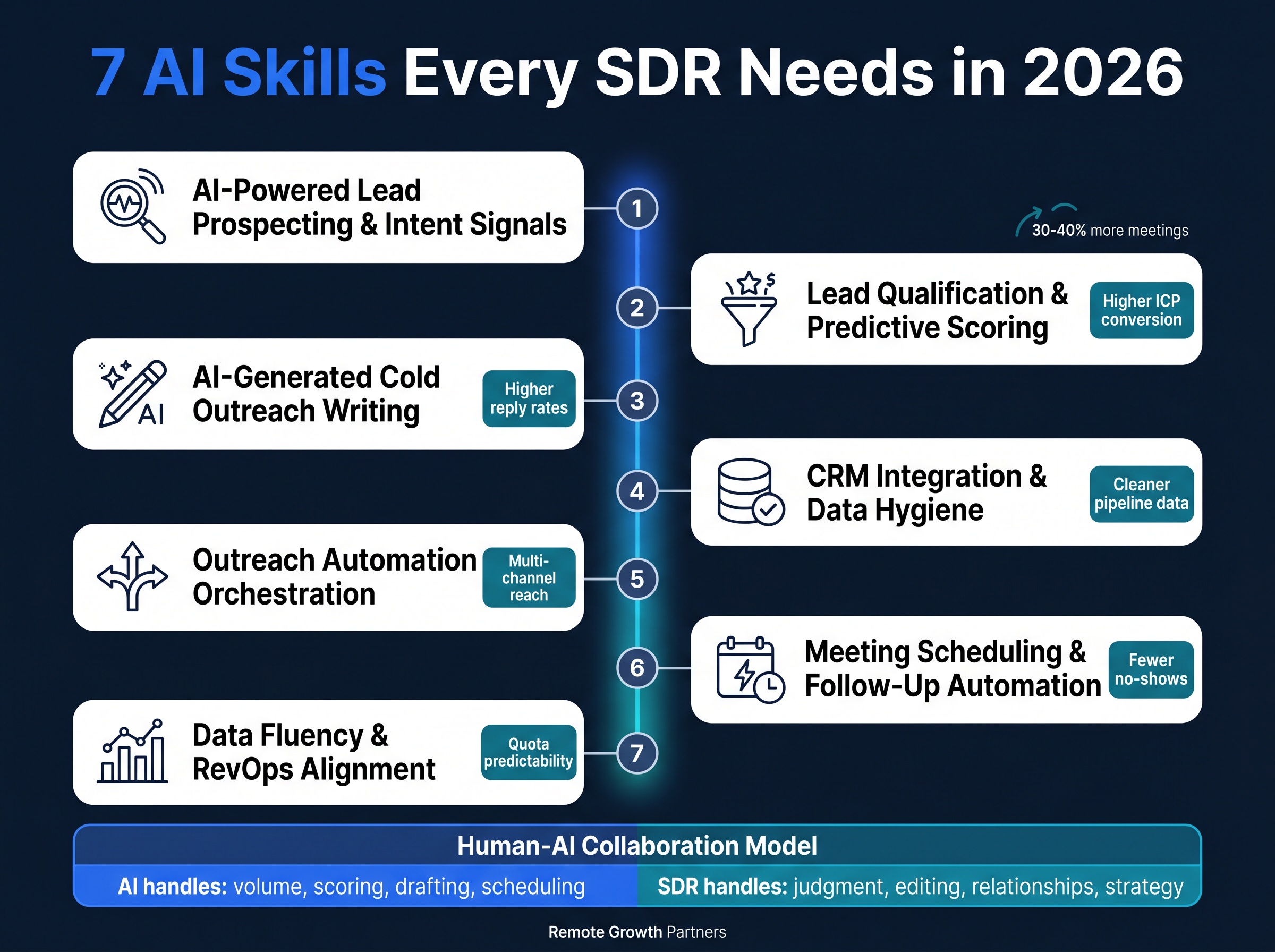
In 2026, SDRs need proficiency in seven core areas: using intent data tools like Apollo, Clay, and Bombora for lead prospecting; applying AI-driven predictive scoring models for lead qualification; prompting and editing AI tools like ChatGPT and Claude for cold outreach; maintaining CRM data hygiene in HubSpot or Salesforce; orchestrating multi-channel automation in Outreach or Salesloft; using tools like Chili Piper for meeting scheduling and follow-up; and reading pipeline dashboards for data fluency and RevOps alignment.
SDRs use AI tools like ChatGPT, Claude, and Lavender to draft personalized cold email sequences based on prospect-specific research and trigger events. The process requires strong prompt engineering skills, providing the AI with the prospect's trigger, ICP pain point, desired tone, and word count limit, followed by a mandatory human edit layer to remove generic language and add context that makes the email feel written for one person. Average reply rates for well-executed AI-assisted outreach reach 8–15% compared to 1–5% for generic cold emails.
An AI SDR is a fully automated software platform (like Amplemarket, 11x, or Artisan) that handles prospecting, personalization, sequencing, and outreach without a human rep. A human SDR working with AI tools is an orchestrator: they configure the automation, review outputs, apply judgment on which accounts to prioritize, handle responses, and iterate on performance data. AI SDR platforms excel at volume; human SDRs excel at judgment, relationship nuance, and adapting strategy in real time based on context that automated systems cannot fully process.
The most widely used AI prospecting tools for SDRs in 2026 include Apollo.io for contact data and intent signals, Clay for multi-source data enrichment and AI research automation, LinkedIn Sales Navigator for social prospecting and buyer intent alerts, Bombora for B2B company-level intent data, and ZoomInfo for contact enrichment and trigger events (called "Scoops"). Effective SDRs layer these tools rather than relying on one, using Clay workflows to combine and enrich data from multiple sources before prioritizing outreach.
Yes. AI tools integrated with platforms like Outreach, Salesloft, and HubSpot can automate follow-up emails based on behavioral triggers, such as opening an email without replying, clicking a scheduling link without booking, or missing a confirmed meeting. The SDR's role is to write the follow-up copy in advance (keeping it under 60 words, peer-to-peer in tone, and specific to the meeting context) and configure the trigger logic correctly. Automated follow-ups that sound human consistently outperform generic "just checking in" sequences.
Data fluency for SDRs means the ability to read pipeline dashboards, interpret conversion rate trends (reply rate, meeting-to-opportunity rate, pipeline generated per account), identify which outreach variables are driving results, and communicate findings to RevOps or sales leadership. It is distinct from general tech comfort, it requires understanding which metrics actually predict quota attainment rather than just tracking activity counts. SDRs who track and act on conversion metrics hit quota at 23% higher rates than those focused solely on activity-based goals like calls made or emails sent.
CRM data quality directly determines the quality of every AI output downstream. If contact records in HubSpot or Salesforce are incomplete or inaccurate, predictive scoring models rank the wrong accounts, personalization tokens surface wrong information, and follow-up automation fires on incorrect triggers. Salesforce research estimates poor CRM data quality costs B2B sales teams 27% of annual revenue through bad prioritization and missed follow-ups. SDRs who treat CRM logging as core infrastructure, not admin overhead, create a compounding data advantage that improves AI performance across the entire team over time.
Recruiting, testing, and interviewing the most talented SDRs, designers, video editors, and marketers from overseas.



.jpg)